



Key Metrics
The Silica storage system is assessed based on the following key metrics:
-
Voxel quality, Q = B/nV, represents the average bits per voxel obtained from the total user bits, B, across numerous voxels, nV. Here, Q < Qw (where Qw denotes bits per voxel) due to redundancy added for error correction. We define q = Q/Qw, which acts as the quality factor (refer to ‘Redundancy Optimization and Error Correction’). All metrics, except for lifetime, relate to Q.
-
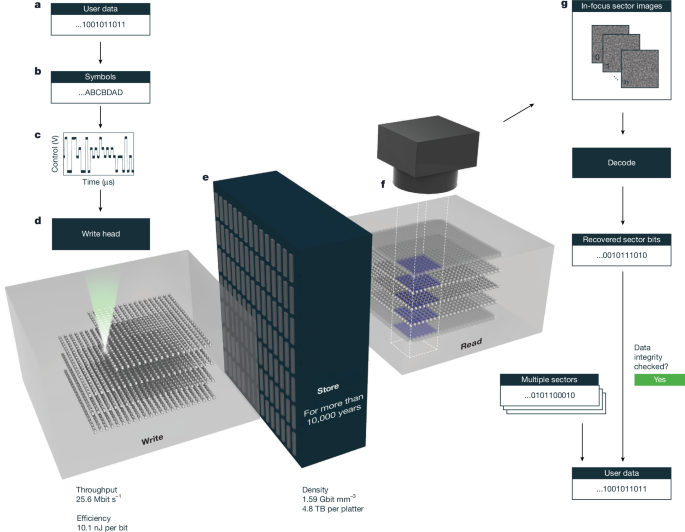
Data density, ρ = Q/V, signifies the voxel quality achievable within a glass volume V (Gbit mm−3), where V is derived from the product of the x pitch, y pitch, and the effective z pitch (total 2 mm thickness divided by number of written layers).
-
Usable capacity indicates the maximum user bits that can be accommodated in one 120 mm square, 2 mm thick glass platter. This number is adjusted by a factor of 0.747 to reflect engineering overheads, expressed in TB per platter.
-
Write throughput, θ = fNLQ, where f is the laser repetition rate and NL represents the number of beam lines, defines the data writing speed to glass, measured in bits per second, specifically peak throughput.
-
Write efficiency, η = E/Q, quantifies the energy utilized for writing each user bit (in nJ per bit), with E measured post-objective. A lower η indicates better efficiency, allowing more bits to be written in parallel using the same laser pulse energy.
-
The lifetime metric provides an experimental estimate regarding the duration data remains intact in the glass (consult section ‘Lifetime’).
Writing Process
Figure 2a highlights the essential components of the data writing system. The data is initially sourced from an amplified femtosecond laser (Amplitude Systems, Satsuma HP3), featuring a 516 nm central wavelength (second harmonic) and a tunable pulse duration ranging from 300 fs to 1,000 fs. We assess the laser pulse duration pre-objective using a Gaussian fit of the autocorrelator signal (APE, Carpe).
The output laser pulse train operates at 10 MHz, passing through a tunable attenuator and a quartz half-wave plate adjusted via a motorized rotary stage, along with a Glan linear polarizer.
Tunable Beam Splitter
The attenuated laser beam is bifurcated into seed and data beams via either an acousto-optic deflector (AOD) or a polarization grating (PG) beam splitter. The AOD offers flexible splitting at various angles and power ratios through radiofrequency adjustments. Our standard energy ratio is approximately 100:60–70 for seed to data pulses. The PG beam splitter enables tunability of the angle and power ratio by modifying the relative angles of the PGs and the incoming beam’s polarization.
Polarization Modulator
Post-splitting, the beams traverse a relay lens before hitting two sequential Pockels cells with a 45° crystal orientation. These cells modulate the polarization of both pulse types. Writing is performed using elliptical polarization (ellipticity = 0.5) to enhance efficiency by lowering the required Pockels driving voltages. Custom high-voltage modulators manage the Pockels cells (200 V peak-to-peak with a 10 MHz bandwidth).
Lifetime Conditions
Macroscopic measurements were conducted to assess the durability of phase voxels, focusing on their thermal erasure in platters containing multiple data tracks. Exploiting the 3D periodicity of the modified structures, collimated light beams diffract at distinct angles, presenting a clear optical signature during the beam’s traversal through altered glass.
