


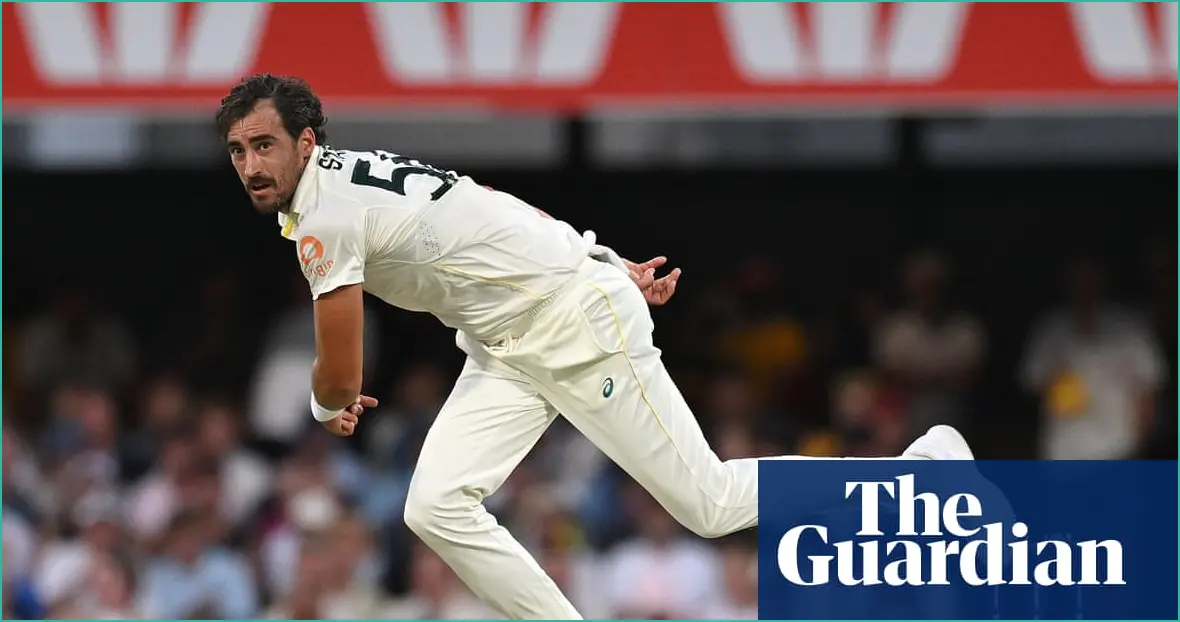
In the second Ashes Test, it was once again Mitchell Starc who stepped up to save the day, as he did in the first Test. While a series intended to spotlight Australia’s fast-bowling Big Three saw Starc as the sole starter, he took six wickets for 46, nearly achieving career-best stats for the fourth time within a year. Despite Joe Root and Jofra Archer rescuing some runs, Starc continues to shoulder Australia’s responsibilities this series.
Having surpassed Harbhajan Singh’s total of 417 Test wickets, Starc’s tally earned him a place among the top 15 all-time wicket-takers in Test history. More notably, he passed Wasim Akram’s 414 wickets, establishing himself as the most successful left-arm fast bowler. Although Starc has a slightly higher average per wicket, he has delivered each wicket in fewer balls, indicating an upward trajectory in his stats.
Starc’s performance mitigated some damage, but England concluded the day at 325 for nine, leaving them in a potentially competitive position. Australia’s secondary bowlers, Scott Boland and Michael Neser, had brief moments of promise early on but only managed to claim one wicket each. Boland struggled later on, while Cameron Green and Brendan Doggett’s economy was poor throughout the innings.
Meanwhile, Nathan Lyon remains sidelined, still two wickets shy of surpassing Glenn McGrath’s 563. Previously an integral part of pink-ball matches, Lyon’s exclusion raises questions about the decision to field five fast bowlers, disregarding the benefits of having a spinner. Going without a spinner is as risky as attending a match unprepared; you may not need one, but it can be regrettable if the situation calls for it.
Assessments prior to the match suggested that pitch conditions would favor pace bowling. However, that doesn’t justify the absence of a spinner in the lineup, as diversity in bowling strategies can be advantageous regardless of conditions. Facing an England team that excels at hitting sixes against spin, Australia should consider employing a spinner on a ground where significant distances need to be covered.
The pitch did not turn out to be a fast-bowler’s paradise, despite a few promising characteristics. While there was bounce and some early swing, it became evident that runs could be scored when England disciplined themselves, unlike the self-sabotage exhibited by parts of their batting lineup. By holding back Starc for a dusk session after his initial success, Australia missed varied bowling options, allowing Joe Root to settle into a commanding unbeaten century.
Instrumental to Australia’s progress on this day was not only Starc’s contribution but also the questionable decisions leading to Lyon’s omission. Given Lyon’s established track record in pink-ball cricket, the decision-makers seem to be overlooking logic. Ultimately, Starc’s performance was essential for Australia’s outcomes, not the selections comprising the rest of the bowling unit.
