


Baseball enthusiasts recognize the scenario: a sharp ground ball gets past the third baseman, a slow roller leads to a hurried throw, or a spectacular diving stop results in an infield single. In those critical moments, all eyes turn to the scoreboard, eagerly anticipating the decision that will classify the play as a hit or an error. Up in the press box, one individual is responsible for making that judgment.
For over two decades, that individual in Detroit has frequently been Ron Kleinfelter, a seasoned Major League Baseball official scorer from Perrysburg. His role requires strict adherence to the rulebook, quick decision-making, and attention to details that most fans overlook. It’s not a glamorous position, nor is it loud, but it carries significant weight.
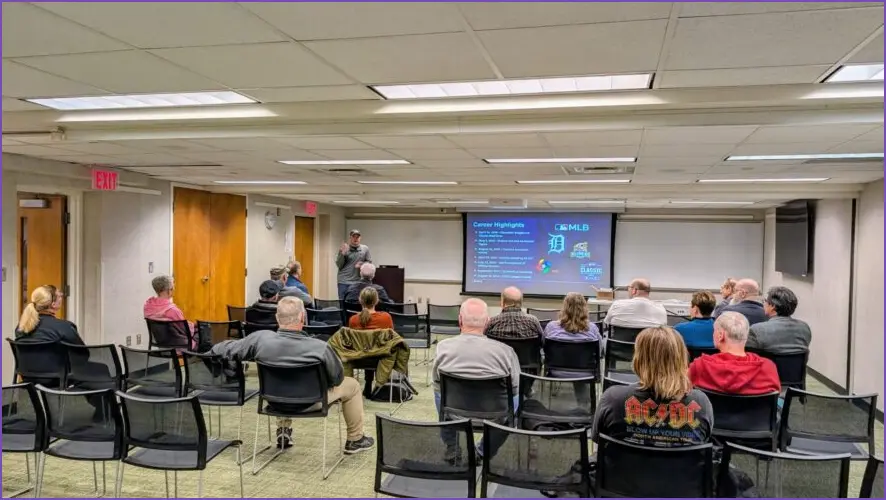
“Many people think I get paid just to watch baseball, but that’s not the case,” Kleinfelter explains. “I’m focused on everything happening on the field at any given moment.” On November 16, during an event at the Way Public Library, he took the opportunity to enlighten fans about the intricate thought processes behind the calls they react to nightly.
A Passion for Scorekeeping
Kleinfelter shared that his journey into MLB scoring didn’t stem from playing the game or connections in the front office, but rather from an early love for scorecards. He fondly recalls attending Cincinnati Reds games in the late 1970s, where he became captivated by how his father recorded the game, fascinated by the symbols, organization, and how the entire contest could be chronicled on paper. By 12, he was keeping score of televised games.
Serendipitous Beginnings
His entry into professional scoring was a fortunate twist of fate in 1999 when the Mud Hens needed a scorer. Thanks to a friend’s endorsement, he was behind the scorecard for his first professional game on April 14, 1999, at the now-closed Ned Skeldon Stadium. “It was truly a classic ‘right place, right time’ moment,” he reflected.
The Foundation of Scoring Decisions
Across more than 1,000 games scored between Detroit and Toledo, Kleinfelter emphasizes that every scoring decision hinges on two words: ordinary effort. This standard determines whether a play is classified as a hit or an error. “If a shortstop has to dive for the ball, that’s typically beyond ordinary effort,” he stated. “You can’t penalize a fielder for failing to make an extraordinary play.”
Managing Time Constraints
Even after years in the role, the pace remains relentless. Scorers have only about 30 seconds to make their decisions before the next batter steps up. MLB facilitates this with a replay support system known as NORAD, allowing Kleinfelter to access alternative angles quickly. “I can search for angles that in-stadium scorers can’t find in the moment,” he explained.
Embracing Community Roots
Despite the prominence of his role in major league baseball, Kleinfelter remains connected to his community in Perrysburg. He appreciates the strong ties between Perrysburg and Detroit’s baseball legacy, noting various local icons who have made an impact on the Tigers. “I take pride in my roots,” he affirmed, maintaining a low profile both in the press box and around town.
