


Philadelphia Eagles Show Progress Despite Offensive Changes
This game marked another positive development for the Philadelphia Eagles, even though their offensive design diverged from the previous week. Against Washington, the Eagles utilized more empty formations and 11 personnel. While this represented a shift from the under-center approach I praised before, it didn’t feel like a step back. Instead, it seemed like the coaching staff adapted to the defensive strategies presented, avoiding a rigid style of play.
In the early stages, the Eagles effectively employed empty formations, a strategy that made perfect sense. Washington chose to remain in base personnel against the Eagles’ 11, which invited them to spread out the defense. Jalen Hurts appeared relaxed and confident in empty sets, as has often been the case. His decisive decision-making and clean processing made the offense seem less predictable than it had earlier in the season, indicating clear progress.
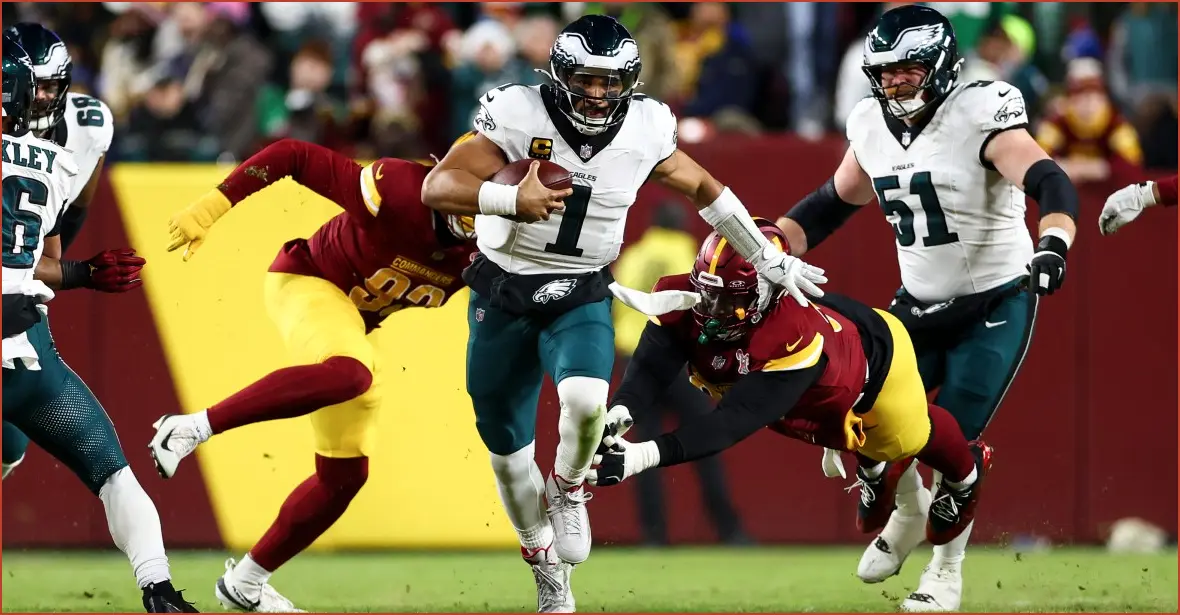
When Washington switched to two-high defensive looks, the Eagles remained composed. Hurts didn’t force throws but instead utilized the space created by empty formations to escape and scramble. This strategy highlighted one of the advantages of using empty formations with a mobile quarterback: they provide more room, clearer reads, and cleaner escape routes. Hurts made excellent decisions, and his scrambles felt controlled and not chaotic; in fact, he managed to avoid unnecessary hits during these runs.
Washington opted for single-high coverage on their first drive to limit Hurts’ scrambling ability. This resulted in a favorable 2v2 matchup outside, ideal for a slot fade. That drive stood out as one of the best of the season, and credit goes to Kevin Patullo for the play design. Although DeVonta Smith initially dropped the pass, he quickly redeemed himself.
Throughout the game, Hurts demonstrated remarkable efficiency as a dropback passer when the situation was structured well. There’s a lot of misinformation online regarding his ability to read defenses, but consistently good performance shows that his pre-snap process is robust. While he may not be the guy to connect every time on a deep read, he effectively adjusted to Washington’s attempts to limit explosive plays by finding available options and delivering the ball promptly.
Moreover, the run game had its ups and downs throughout the match. While the overall rushing performance was solid, some earlier plays were disappointing. The QB counter bash that worked well last season hasn’t been effective this year. Issues with blocking assignments, particularly with Grant Calcaterra and Jordan Mailata, impacted the run game’s success. Mailata has had an unusually high number of disappointing blocks, leading to wasted downs when Calcaterra is on the field.
This game’s run game found its rhythm as it progressed, steered more towards straightforward inside zone runs rather than outside zones. The offensive line improved their performance, which helped Saquon Barkley break through the second level successfully. If the Eagles can consistently run inside zone effectively, this will enhance their overall offensive strategy. Hurts’ ability to maintain the threat of his run, particularly in shotgun formations, remains crucial for the team’s success.
In conclusion, while the Eagles may not yet have a defined offensive identity, the adaptability and efficiency they’ve shown against different defensive strategies is encouraging. Incorporating empty formations, under-center plays, and effective inside zones points toward a promising trajectory. As long as they continue to adapt and take advantage of what opponents give them, the Eagles’ offense could thrive going forward.
