


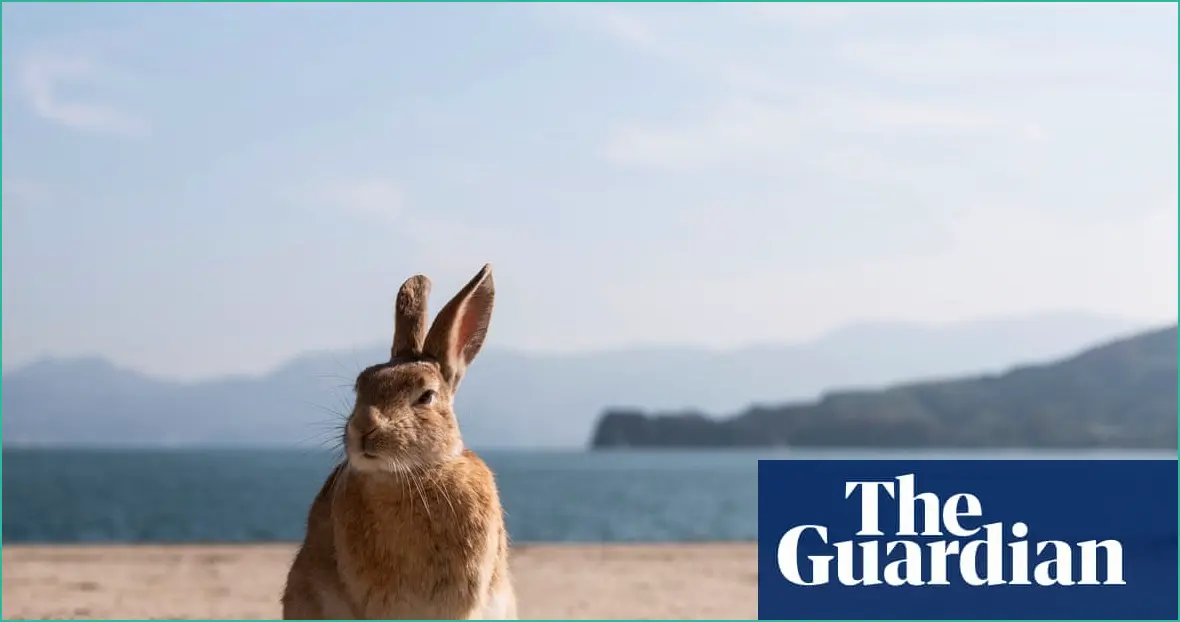
Upon arrival, the ferry’s bunny-ear decorations offer little indication that passengers have landed on a rabbit-populated island. Shortly after disembarking, however, rabbits begin to emerge from the underbrush, seemingly unfazed by the visitors.
A brief stroll along the coastline leads tourists into the heart of Okunoshima, one of the 3,000 islands in Japan’s Seto Inland Sea. Here, several rabbits chase away one who attempts to join their communal feast of Chinese cabbage, all while delighted tourists capture the moment on camera, astonished by the island’s famous yet troubled furry inhabitants.
Two grey rabbits that initially greet the ferry retreat to bushes denuded of leaves. Scattered shallow bowls of water, provided by volunteers, serve areas where around 400–500 rabbits gather, hoping for edible treats from visitors, as their natural diet of leaves, bark, roots, and grass is scarce.
Despite its picturesque scenery and status as a tourist haven, Okunoshima—home only to hotel staff and guests—faces an uncertain future alongside its rabbit population. Historically, from 1929 until the end of World War II, the island was a site for poisonous gas research and production by the Japanese imperial army, shrouded in secrecy.
Rubber-clad workers once produced mustard gas and smaller amounts of tear gas and cyanide. This era also marks the beginning of Okunoshima’s association with rabbits, as about 200 were used in experiments to assess the effectiveness of chemical agents, which were deployed during the Sino-Japanese war and used for military balloon bombs aimed at the US.
In the early 1970s, a nearby elementary school released some rabbits onto the deserted island in hopes of revitalizing it. By 2024, nearly 200,000 visitors flocked to Okunoshima, attracted by its Instagram-worthy coast and the allure of a rabbit haven.
As concern for the rabbit population increases, many fear that the island’s historical context may be forgotten. Kazuhito Takashima, manager of the Poison Gas Museum, highlights that most visitors come solely for the rabbits, often overlooking the island’s toxic legacy. As tourists depart on the Lapina pleasure boat, they capture final glimpses of the rabbits, unaware of the darker history entwined with their lighthearted visit.
