


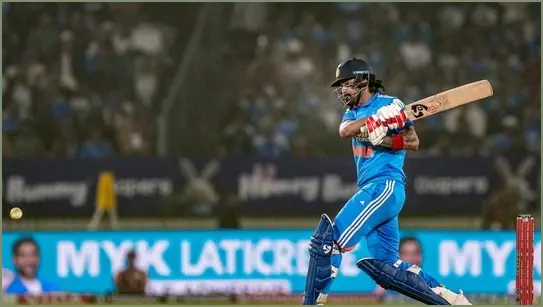
For over fifteen years, India’s approach to ODI chases revolved around a straightforward idea: as long as MS Dhoni was at the crease, the match remained in hand. His skill lay not just in finishing games but in transforming tension into a manageable process. Since Dhoni’s departure, India has sought that stabilizing influence—not the charisma, captaincy, or myth, but the practical ability to close out a chase without allowing chaos to take hold.
Recent years suggest that KL Rahul may embody a modern equivalent of that critical role. While comparing him to Dhoni can be tricky given Dhoni’s monumental influence, the statistics show that in crucial ODI chases, Rahul’s performance is worthy of recognition.
The Dhoni Benchmark: Survival as a Superpower
MS Dhoni’s hallmark in successful chases wasn’t merely his speed but his consistent presence when it mattered. Throughout 75 innings in winning ODIs, he remained not out 47 times with an impressive average of 102.71 and a strike rate of 88. Two aspects stand out:
- First, the volume: 75 innings in successful chases signify a long-standing identity rather than a passing phase.
- Second, the not-out ratio: finishing unbeaten in about two-thirds of those innings ensures his remarkable average is more a product of stability than speed.
This exemplifies elite finishing: minimizing risk while under pressure. Dhoni approached the game with the mindset of a risk assessor, reducing chances of loss rather than merely seeking victories.
Rahul’s Chase Footprint: Smaller Sample, Similar Logic
KL Rahul’s performance in similar contexts resembles a finisher rather than a mere accumulator. He has played 25 innings with 13 not outs, racking up 1,000 runs at an average of 83.33 and a strike rate of 82.64, including two centuries and six fifties.
When examining his not-out rate, Rahul remains unbeaten in 52% of these successful chases, a hallmark of a closer. This consistency indicates he commonly finishes matches at the crease, akin to what made Dhoni exceptional.
The Real Overlap: Sequence Over Style
While the superficial comparison with Dhoni emphasizes “calmness,” the meaningful connection lies in their approach to sequences.
Dhoni’s best chases typically followed this pattern:
- Absorb early losses if wickets fall.
- Maintain a manageable required rate.
- Guide the game deep while conserving wickets.
- Close the match effectively.
Rahul’s data indicates a similar approach. His centuries in successful chases often reflect a lengthy responsibility, guiding partners, adjusting the pace, and ensuring he remains until the end.
Where Rahul Differs—and How It Benefits Modern India
Dhoni excelled in an era where teams were still mastering the final 15 overs of ODIs. Today’s game has evolved: teams initiate attacks earlier, strategic match-ups are commonplace, and “safe” phases have shortened. Rahul’s ability to navigate through varied tempos without a noticeable shift makes him particularly valuable.
He does not present himself as a one-dimensional finisher arriving to swing at the end. Instead, he acts as a connector—ensuring that the chase doesn’t mutate into a scenario demanding unprecedented performances. This is why his not-out rate is as critical as boundary counts; preserving wickets is essential in modern ODIs.
Conclusion: KL Rahul Didn’t Replace Dhoni—He Rebuilt the Function
While Dhoni remains an unmatched figure in chase statistics, Rahul’s successful records indicate that India now has a finisher who grasps the essence of Dhoni’s approach: the key to a chase is not just the final shot, but the discipline to manage the game before it reaches that critical point.
Rahul is not merely Dhoni’s successor in persona but represents a more valuable asset: a modern ODI batter reviving India’s reassuring sentiment in chases—that outcomes can be managed and not merely endured.
