


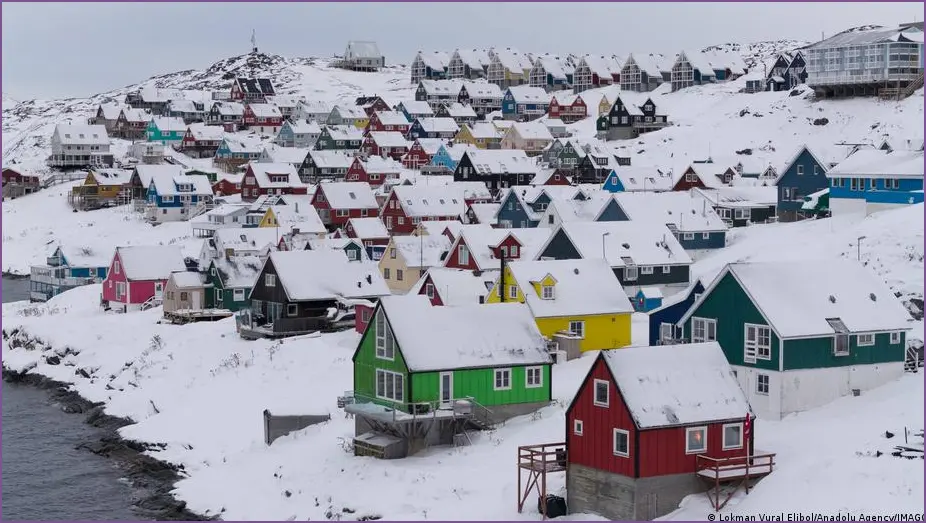
A self-governing territory of Denmark located thousands of kilometers from the US is currently at the center of a geopolitical conflict.
President Donald Trump has labeled it “unacceptable” that Greenland remains outside US control and has threatened tariffs against nations that oppose his agenda.
Although geographically situated in North America, its association with Denmark renders it European both culturally and politically.
In response, the citizens of Denmark and Greenland, along with their governments, are actively resisting Trump’s initiatives, while other nations like Europe, China, and Russia evaluate Greenland’s strategic significance.
What is the strategic significance of Greenland?
Trump’s recent discussions about purchasing or intervening in Greenland may be new, but the US has valued this Danish territory for decades.
In fact, the idea of annexing Greenland was proposed as early as 1867 by then-Secretary of State William Seward. During World War II, the US occupied the territory to prevent it from being overtaken by Nazi Germany. The US currently manages the Pituffik Space Base, a military installation in northwestern Greenland, following the 1951 Defense of Greenland Treaty signed with Denmark.
How large is Greenland?
Greenland is enormous. While it may be smaller than countries like the US, Russia, Canada, and China, it is still six times the size of Germany (approximately 2.17 million sq km compared to Germany’s 357,000 sq km).
In fact, it is over half the size of the entire European Union and holds the title of the largest island in the world, with Australia being categorized as a continent.
What is Greenland’s population like?
The population of Greenland is merely 56,000, making it the most sparsely populated region on Earth at about 0.14 individuals per square kilometer.
This scarcity is largely due to its geography, with 80% of the land covered by an ice sheet formed around three million years ago, rendering vast areas uninhabitable. Over 65% of the people reside in Greenland’s five largest communities: Nuuk (the capital with 19,905 residents), Sisimiut (5,485), Ilulissat (5,087), Qaqortoq (3,069), and Aasiaat (2,992).
How is climate change affecting Greenland?
Greenland is experiencing rapid climate change similar to the rest of the Arctic. Temperatures are increasing dramatically, as exemplified by the Ittoqqortoormiit weather station recording a temperature of 14.3 degrees Celsius on May 19 last year, which is over 13 degrees Celsius higher than the average maximum for May.
This change has led to the diminishing of the island’s ice sheet for 29 consecutive years, according to the 2025 Geological Survey of Denmark and Greenland (GEUS). “On average, the Greenland Ice Sheet has lost about 140 billion tonnes of ice annually since 1985,” stated Signe Hillerup Larsen from GEUS.
What natural resources does Greenland hold?
Greenland is rich in natural resources, possessing at least 25 out of the 34 raw materials classified as critical by the European Union. While it has substantial deposits of iron ore, gold, and uranium, the challenging geography, weather, and limited infrastructure hinder resource extraction.
The territory’s rare earth elements (REEs) are particularly desirable, as the US lacks a dependable supply chain for these materials that are crucial for products ranging from electric vehicles to military applications. Currently, around 60% of REEs are sourced from China, which processes over 90% of them, making Greenland essential in the effort to reduce reliance on Chinese supplies.
