


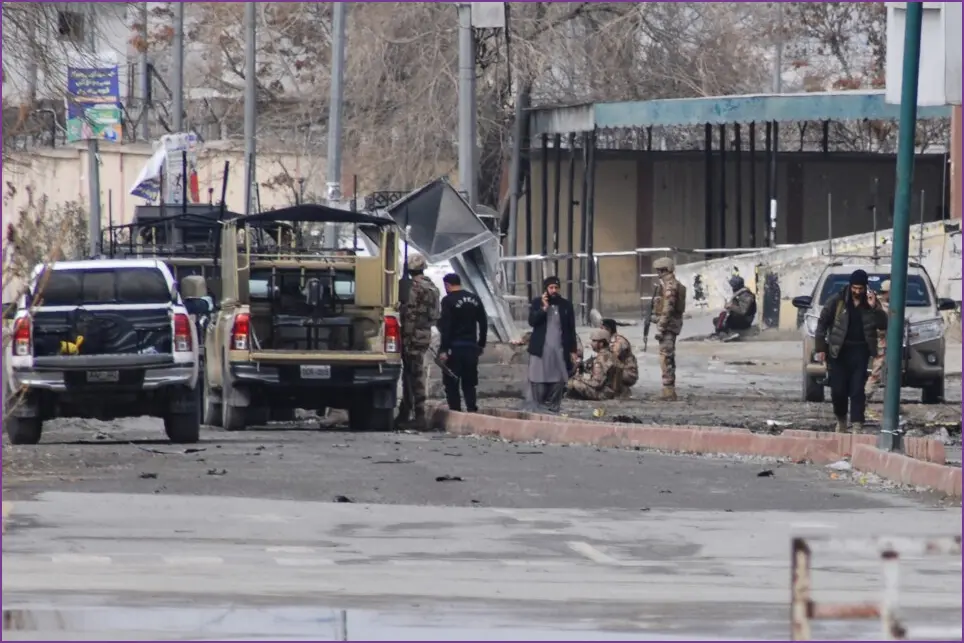
QUETTA, Pakistan (AP) — Separatist groups from Balochistan claimed responsibility for a series of nearly a dozen coordinated attacks across southern Pakistan early Saturday, targeting civilians, a high-security prison, police stations, and paramilitary facilities. Authorities reported that eleven civilians, ten security personnel, and sixty-seven insurgents were killed in the attacks.
While Baloch separatists and the Pakistani Taliban frequently strike security forces in Balochistan and other areas, such extensive coordinated assaults are uncommon. Officials revealed that over the past 48 hours, at least 108 militants have been killed throughout Balochistan, with 67 fatalities occurring just on Saturday. Analysts noted this marked one of the deadliest single days for militants in decades.
The deceased included eleven civilians, comprising three women and three children, in Gwadar, according to police official Ibad Khan. He confirmed that the victims were ethnic Baloch, and police responded swiftly to neutralize all attackers.
Pakistan’s Interior Minister, Mohsin Naqvi, indicated that ten security personnel lost their lives in these assaults. The banned Baloch Liberation Army (BLA) claimed responsibility, as some banks were looted and a police station along with numerous vehicles were set ablaze. The BLA also released videos featuring female fighters participating in the attacks, seemingly aimed at promoting the role of women among the militants.
Shahid Rind, a spokesman for the Balochistan government, reported that most attacks were prevented. These incidents occurred shortly after the military announced that security forces had conducted raids on two militant hideouts in the southwest, resulting in the deaths of 41 insurgents. Provincial Chief Minister Sarfraz Bugti stated on social media that security forces were actively pursuing the remaining insurgents, mentioning a total of at least 700 insurgents neutralized over the past year.
Balochistan police and government sources indicated that at least 37 assailants were initially killed, with an additional 30 tracked down and killed later. Earlier that day, insurgents were also reported to have destroyed rail tracks, causing Pakistan Railways to suspend train services from Balochistan to other regions.
Targets Were Police, Prison, Paramilitary Forces, and Civilians
The attacks began almost simultaneously throughout the province, said provincial Health Minister Bakht Muhammad Kakar. Two police officers perished in a grenade strike on a police vehicle in Quetta, prompting the government to declare a state of emergency across all healthcare facilities. Various insurgents attacked a prison in the Mastung district, freeing more than 30 inmates, while other assaults targeted paramilitary headquarters in Nushki district, which were repelled.
The BLA is prohibited in Pakistan and categorized as a terrorist organization by the United States. It has conducted numerous attacks in recent years, with Pakistan asserting that the group is supported by India, a claim that New Delhi refutes. Pakistan has continuously maintained that Baloch separatists, the Pakistani Taliban, and other radicals use Afghan soil to launch attacks, a statement that Kabul dismisses.
Deadliest Day for Militants
Abdullah Khan, director of the Islamabad-based Pakistan Institute for Conflict and Security Studies, stated that “terrorists linked to BLA or other factions have never faced such significant casualties in a single day” in Balochistan. Baloch separatist groups and the Pakistani Taliban, also known as Tehrik-e-Taliban Pakistan (TTP), have ramped up assaults across Pakistan in recent months. While the TTP operates independently, it is allied with the Taliban regime in Afghanistan, which regained power in August 2021. The region of Balochistan has been a longstanding battleground for separatist movements aiming for independence from Pakistan’s central government in Islamabad.
____
Ahmed reported from Islamabad. Associated Press writers Babar Dogar in Lahore and Ishtiaq Mahsud in Dera Ismail Khan contributed to this report.
