


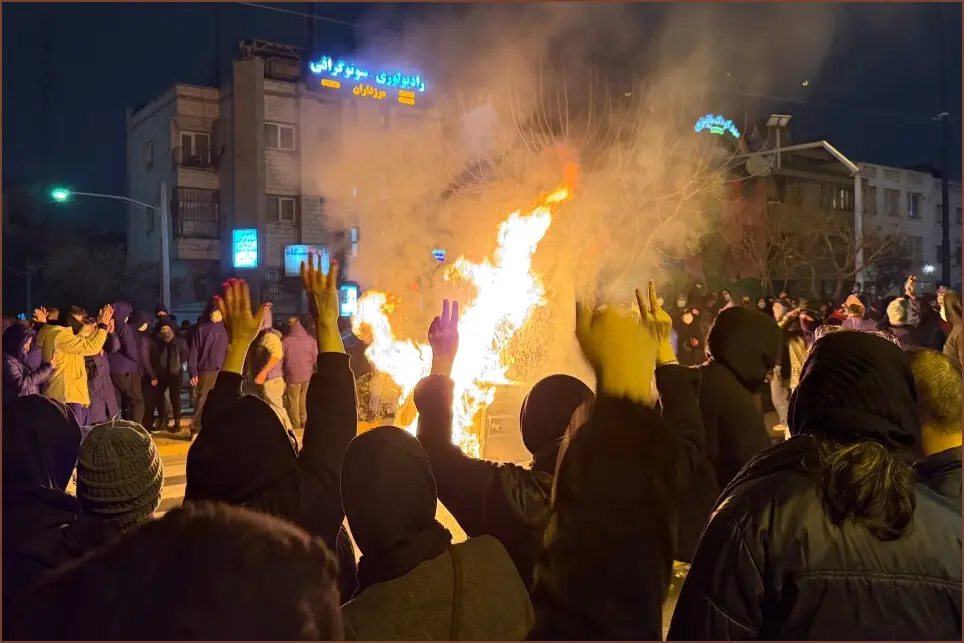
Protests in Karaj
BEIRUT (AP) — As tear gas was fired into the crowd, a 37-year-old beautician and her friends sought refuge under trees in the darkened streets of Karaj, illuminated only by streetlights and nearby flames.
Gunfire erupted, clearly audible in the video she recorded on her phone.
“Don’t be afraid,” she shouted, her voice trembling, while the crowd echoed her sentiment, chanting, “Don’t be afraid. We are all together.”
“Are they shooting live rounds?” she screamed, expressing outrage. The crowd joined in, chanting “Death to the dictator!” This display of courage unfolded on January 8, during a nationwide protest against the long-standing clerical regime in Iran. Yet, following the violence of that night, the beautician retreated into a state of fear and anxiety, moving in with her mother and struggling to find peace.
Shadows of Fear
She described a pervasive atmosphere of fear that has descended upon Iran, coupled with deep sorrow and quiet anger. In a message sent in late January, she observed, “People in the streets look like walking corpses, devoid of hope.”
Her video accounts capture the initial enthusiasm of the protesters and the shock that followed in the wake of the regime’s most brutal crackdown. She lamented the lost hope for change and a feeling of being abandoned by the international community.
Aftermath of Violence
Monitoring organizations report at least 6,854 deaths, mostly occurring on January 8 and 9, with some estimating the real number could be three times higher. An unprecedented crackdown has followed, including a month-long internet blackout that has obscured the true extent of the situation, during which over 50,000 individuals have reportedly been detained.
Economy and Disillusionment
The beautician struggled in a faltering economy plagued by corruption and sanctions. With few job opportunities, she decided to work as a nail technician, hoping for a better livelihood. Her relative noted that she had abandoned her dream of starting a family due to the oppressive environment and escalating costs of living. Despite her skepticism towards Iranian politicians, she found hope in the potential for change and actively participated in protests.
January 8 Protests
On January 8, a surge of Iranians gathered in at least 192 cities across the country, marking one of the largest anti-government demonstrations since the Islamic Revolution of 1979. The beautician’s footage reveals crowds confidently filling a Karaj boulevard, chanting against Supreme Leader Ali Khamenei, amidst a mix of social and economic backgrounds.
Escalation of Violence
The beautician’s videos depicting the chaos show protesters outside a police station when the violence escalated. She recounted witnessing nearly 20 people shot in her vicinity and the fatalities of friends and family trying to assist the injured. Fearing for her safety, she noted how the atmosphere of dread has kept her confined to her home since that night.
A Grieving Nation
As violence persisted, she felt compelled to stay indoors, fearing the arrival of security forces. Despite taking tranquilizers, she struggled to find rest, expressing anxiety about potential raids. “We have weathered so much before, but now,” she expressed, “we are all in mourning, overwhelmed with anger that we can barely voice, out of fear for our safety.”
