


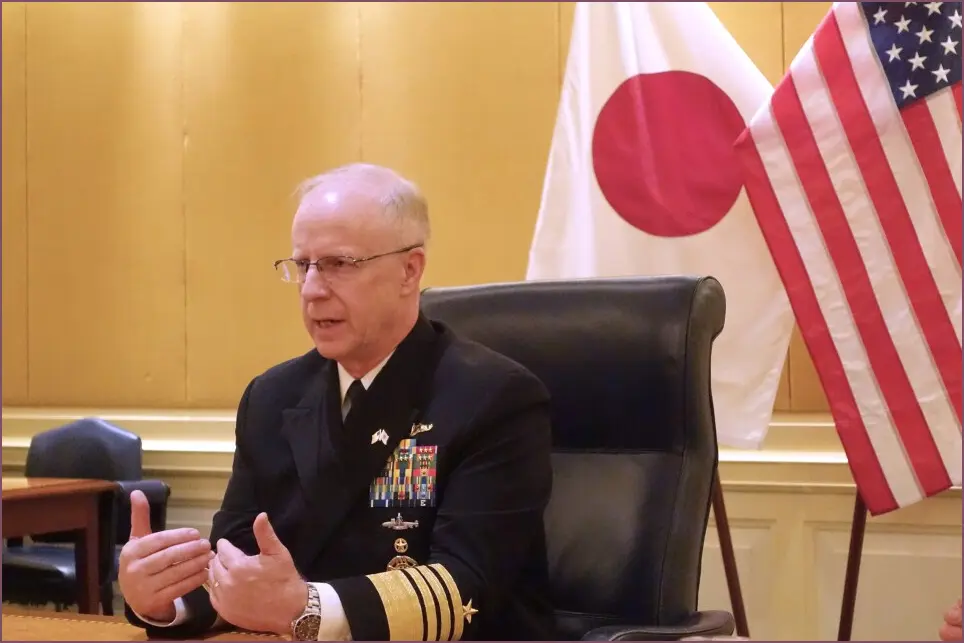
WASHINGTON (AP) — The U.S. Navy’s leading officer is advocating for the adoption of smaller and more modern ships for various missions, rather than relying predominantly on massive aircraft carriers. This shift is particularly evident in the current military presence near Venezuela and Iran.
Admiral Daryl Caudle refers to his strategy as his “Fighting Instructions,” which aims to deploy more customized groups of ships and technology, enhancing the Navy’s ability to react to unfolding crises.
In an interview with The Associated Press, Caudle discussed the strategy’s introduction during a time when the Trump administration has redirected aircraft carriers and other vessels worldwide, addressing urgent issues. This has led to disruptions in planned deployments and increased stress on ships already facing maintenance challenges.
The USS Gerald R. Ford, the largest aircraft carrier, was reassigned from the Mediterranean to the Caribbean last year to support an operation against former Venezuelan President Nicolás Maduro. Recently, the USS Abraham Lincoln was deployed to the Middle East amid rising tensions with Iran, having been relocated from the South China Sea.
Caudle indicated that his strategy aims to streamline Navy operations in regions like the Caribbean, focusing on effective interdiction and monitoring of commercial shipping. He believes these tasks can be performed without requiring a carrier strike group and could be effectively managed with smaller littoral combat ships, helicopters, and close coordination with the Coast Guard.
To further enhance capabilities, Caudle plans to increase the use of drones and robotic systems, allowing military commanders to achieve their objectives without heavily relying on traditional Navy ships. He acknowledges that integrating these new systems will require an educational effort for commanders and their staff.
Caudle emphasized that he has already successfully implemented this tailored approach in Europe and North America over the past few years. He also highlighted the growing significance of the Arctic region due to increasing focus from China, Russia, and the U.S., proposing that his tailored force packages would provide better solutions to commanders in these critical areas.
