


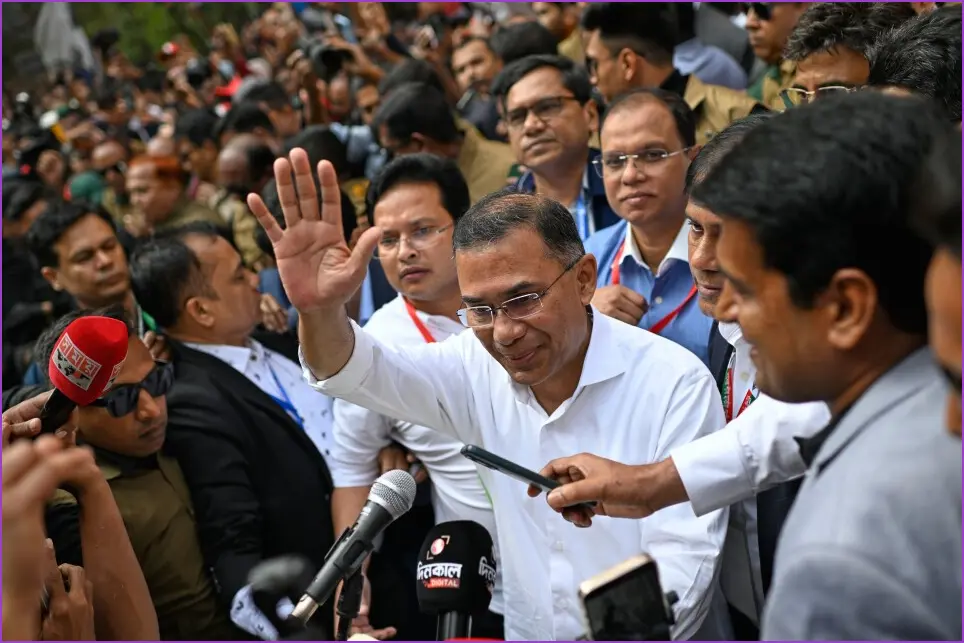
DHAKA, Bangladesh (AP) — The Bangladesh Nationalist Party (BNP) has declared its victory in the nation’s first election following the 2024 uprising, setting the stage to form a new government and potentially transform Bangladesh’s political scene after years of fierce rivalry and contested elections.
The party’s media division announced on X that it had won sufficient seats in Parliament to govern independently, although rival party Jamaat-e-Islami expressed concerns regarding delays in result announcements. While the Election Commission has yet to confirm the final results, local media reported that the BNP surpassed the 151-seat threshold required for a majority in the 350-member Parliament, which includes 50 seats reserved for women.
The BNP is led by Tarique Rahman, their prime ministerial candidate who returned to Bangladesh in December after spending 17 years in self-imposed exile in London. He is the son of former Prime Minister Khaleda Zia, who passed away in December.
Senior BNP official Ruhul Kabir Rizvi congratulated the Bangladeshi populace on the party’s electoral success. In a separate statement, Rahman’s press secretary, Saleh Shibly, urged supporters to engage in special prayers during Friday services rather than hold celebratory events.
US, India, and Pakistan Extend Congratulations
The U.S. Embassy in Dhaka congratulated Rahman and the BNP on their victory, labeling it a “historic achievement.” U.S. Ambassador to Bangladesh Brent T. Christensen noted on X that the United States looks forward to collaborating on shared goals of prosperity and security.
Leaders from India and Pakistan also expressed their appreciation for Rahman. Indian Prime Minister Narendra Modi commented on the victory reflecting the trust of the Bangladeshi populace in Rahman’s leadership and expressed eagerness to enhance bilateral relations. Meanwhile, Pakistan’s President Asif Ali Zardari reiterated his nation’s commitment to a strong democratic partnership.
The Political Dynamics
The election represented a significant dual contest between the BNP and an 11-party coalition led by the Islamist Jamaat-e-Islami, a conservative group whose increasing influence has raised alarms, especially among women and minority communities. Despite not achieving a majority, the coalition notably secured at least 77 seats. Shafiqur Rahman of Jamaat-e-Islami won a seat in Dhaka, positioning himself to lead the opposition but criticized the election result handling.
The election, held under stringent security measures, was perceived as a critical evaluation of Bangladesh’s democratic integrity amid rising political violence and concerns over law enforcement. This election, following the chaotic student-led protests in July 2024 that ousted Hasina, represents a pivotal moment to regain faith in democracy and translate public dissent into political change. A referendum on political reforms ran concurrently with the elections, yet results remain pending.
BNP’s Legacy and Future Challenges
The BNP has spent much of the past 15 years in the opposition, boycotting multiple elections while accusing Hasina’s government of electoral fraud and harsh repression. Subsequently, Rahman returned after the dismissal of cases against him, which he claims were politically motivated. His campaign has positioned him as a guardian of democracy in a political realm often dominated by entrenched parties and military interventions.
Rahman’s family legacy, deeply rooted in the country’s political system, has both aided and hindered the BNP. As a long-time rival to Hasina’s now-banned Awami League party, they have significantly shaped the political landscape of Bangladesh. Experts suggest the BNP, while viewed as benefiting from the recent political turmoil, must navigate substantial pressures to reform and differentiate itself from its historical corruption and nepotism.
