


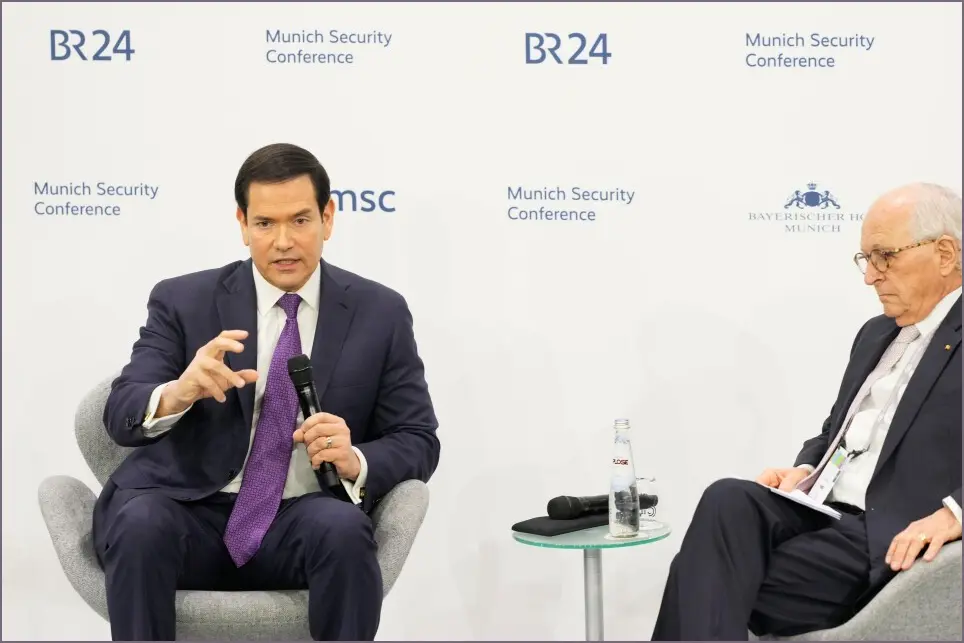
MUNICH (AP) — On Saturday, U.S. Secretary of State Marco Rubio delivered a reassuring address to America’s allies, adopting a more measured yet resolute approach regarding the administration’s plans to redefine the trans-Atlantic alliance after a year characterized by President Donald Trump’s
Speaking at the Munich Security Conference, Rubio emphasized the deep historical ties between the U.S. and Europe, affirming that America will always remain connected to the continent as it advocates for changes in longstanding relationships and institutions foundational to the post-World War II framework.
This year’s conference occurred a year after Vice President JD Vance provoked shock with sharp criticisms of European values. The Trump administration followed this with a series of remarks and actions against allies, including a brief threat from Trump last month to introduce new tariffs on several European nations in a bid to assert U.S. influence over Greenland, a semi-autonomous region of NATO ally Denmark.
Calls for Renewed Trans-Atlantic Trust
German Chancellor Friedrich Merz commenced the 2022 gathering by urging the U.S. and Europe to “repair and revive trans-Atlantic trust together,” emphasizing that the U.S. cannot navigate global challenges independently. He reiterated the commitment to uphold values, including free speech, climate initiatives, and trade.
A Call for Realism
Rubio maintained a calm and reassuring demeanor while also reiterating the administration’s adherence to its policies. He criticized “a climate cult” and noted the crisis from “mass migration” that threatens societal unity. Rubio cautioned against the “dangerous illusion” post-Cold War that liberal democracy would become universal, warning that the ties of trade cannot simply replace national sovereignty.
“Together, we have made these errors, and together we owe it to our citizens to acknowledge the reality and progress towards rebuilding,” he stated, noting that the U.S. might appear “direct and urgent” in its counsel. He emphasized that the end of the trans-Atlantic era is “neither our goal nor our wish,” affirming America’s identification with Europe.
Mixed Reactions from European Leaders
Ursula von der Leyen, President of the European Commission, characterized Rubio’s speech as “very reassuring,” but recognized that some within the administration retain a harsher stance. In her address, she advocated for greater European independence, particularly concerning defense and digital sovereignty in relation to online hate speech.
British Prime Minister Keir Starmer warned against complacency, calling for the UK to strengthen ties with Europe to enhance its own defense capabilities. Hanno Pevkur, the defense minister of Estonia, acknowledged Rubio’s declaration of America as “a child of Europe” but indicated the necessity for continued diligence. Although Rubio did not mention Greenland directly, discussions among the U.S., Denmark, and Greenland regarding Arctic security are ongoing.
Denmark’s Prime Minister Mette Frederiksen held a constructive meeting with Rubio but expressed caution regarding the U.S. desire for control over Greenland, noting that the Greenlandic people prefer to maintain their sovereignty and self-determination.
