


Preparing your audio player…
A groundbreaking study has unveiled that the oldest known dice were made and utilized by Native American hunter-gatherers over 12,000 years ago. Found in the western Great Plains of North America, these ancient gaming tools predate the earliest dice from Bronze Age societies by more than 6,000 years. This research indicates that indigenous peoples were engaged in complex games of chance and exploring concepts of probability long before they appeared in written mathematics.
Redefining the History of Probability
Research led by Colorado State University Ph.D. student Robert J. Madden, published in the journal American Antiquity, pinpointed these ancient dice at archaeological sites from the Late Pleistocene Folsom period in Wyoming, Colorado, and New Mexico. Dating back approximately 12,800 to 12,200 years, these artifacts offer significant insights into the social interactions and intellectual endeavors of early inhabitants of the Americas.
Madden noted, “Historians have typically considered dice and probability to be Old World advancements. However, the archaeological evidence illustrates that ancient Native American societies intentionally created objects for generating random results and used these in organized games thousands of years earlier than previously acknowledged.”
Characteristics of Ancient Dice
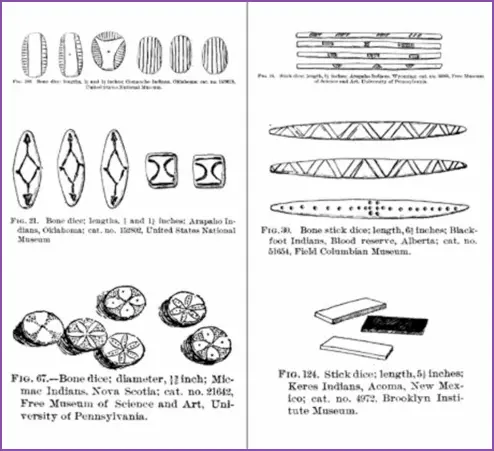
Unlike the cubic dice we recognize today, these early Native American dice were two-sided objects referred to as “binary lots.” Crafted from small pieces of bone, they were typically flat or slightly rounded with oval or rectangular shapes. Designed to fit comfortably in hand, they could be tossed onto a playing surface.
To ensure effective use, the two sides were marked or treated differently. Similar to a coin’s heads and tails, one side was designated as the “counting” side. When thrown, the binary lots would reliably show one side up, creating a simplified outcome for scoring in games.
The Role of Dice in Social Interaction
Madden’s research involved a thorough reassessment of archaeological findings, using a new morphological test to identify North American dice based on a study of 293 sets recorded by the ethnographer Stewart Culin in 1907. This approach led to the discovery of over 600 probable dice from various archaeological sites across North America, indicating a wide array of Native American dice games found in 57 sites across 12 states. These games served as social mechanisms that allowed people to interact, trade, and form alliances, primarily among women.
A Legacy of Probability Exploration
The unearthing of these ancient dice prompts a reevaluation of the history of mathematical thought. Although Ice Age hunter-gatherers may not have developed formal probability theory, they created and relied on random outcomes in rule-based contexts. This early interaction with randomness signifies a vital chapter in the understanding of probability.
Ultimately, these artifacts highlight the creativity and cultural heritage of early Native Americans, underscoring that the human interest in chance and probability extends further back, tracing its origins to the final stages of the last Ice Age on the western Great Plains.
