


The Brazilian Grand Prix of 1992, held on April 5 at Interlagos, starkly highlighted the harsh realities of the Formula 1 hierarchy.
While Williams showcased their technological prowess with the dominant FW14B, achieving a resounding one-two finish led by Nigel Mansell ahead of Riccardo Patrese, the happenings in the paddock vividly illustrated a sport divided into the privileged and the underprivileged.
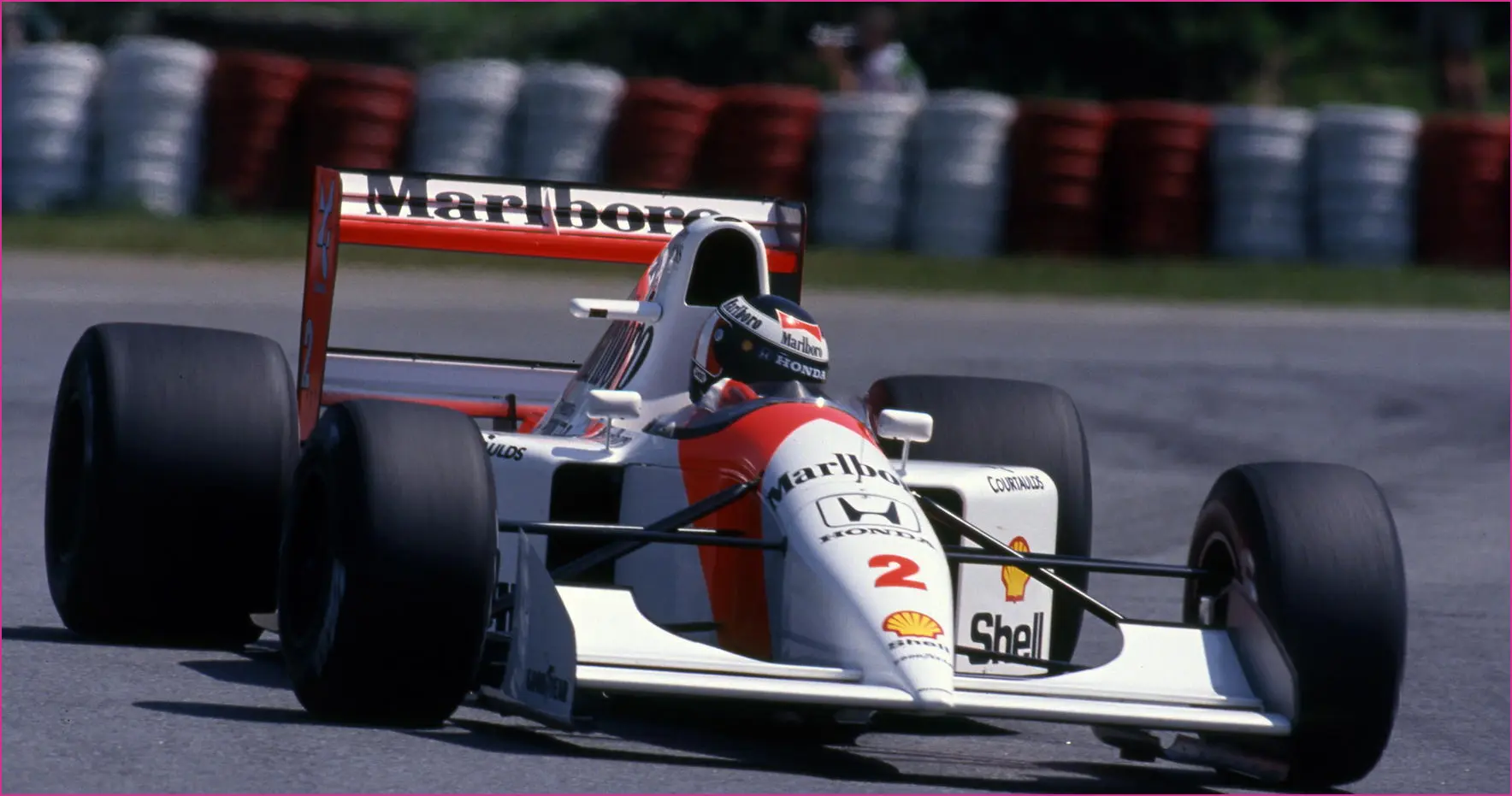
McLaren arrived with six cars, in stark contrast to Andrea Moda, which struggled to field even one.
The sight of the Woking-based team unloading six chassis—three new MP4/7A and three older MP4/6B—was unprecedented in F1 history.
However, reliability issues plagued the newly introduced MP4/7A, which had been rushed into action for this round despite plans for its debut being pushed to Barcelona. An extensive testing program at Silverstone failed to resolve the car’s initial problems, leaving the team faced with the tough choice of either an outdated slow car or a new one that didn’t perform as expected.
This gamble backfired significantly. Ayrton Senna’s Honda V12 suffered from intermittent misfires during the race, leading to struggles in maintaining position while the Williams cars stretched their lead to 22 seconds by the tenth lap.
Perry McCarthy and the Super Licence Farce
While McLaren’s challenges stemmed from their own decisions, Perry McCarthy’s weekend spiraled into a bureaucratic nightmare through no fault of his own.
The British driver had joined Andrea Moda in March after the collapse of Group C racing, leaving him with limited options. He arrived in Brazil having secured his super licence at great personal cost, having sold personal possessions to afford his airfare.
However, on Thursday evening, his licence was taken from him due to a technicality following his failure to set a time in pre-qualifying, a requirement for the slowest teams from the previous season.
With Roberto Moreno managing only two laps before his car failed, posting a slow time of 1:38.569, Andrea Moda’s chances were effectively over.
Bernie Ecclestone eventually intervened on McCarthy’s behalf, pressuring the World Motor Sport Council to reinstate the licence for future events, but by then, the damage was done, and McCarthy did not race in Brazil.
Issues at Andrea Moda
Andrea Moda faced far-reaching troubles beyond the licensing issues. They had been excluded from the season opener in South Africa for not paying the required $100,000 entry deposit.
In Mexico, neither car was able to race as they were still under construction. Original drivers Alex Caffi and Enrico Bertaggia were dismissed after openly criticizing the team’s lack of readiness.
Team owner Andrea Sassetti, an Italian shoemaker with no racing background, had spent $2 million on what McCarthy would later describe as “a couple of old Coloni chassis, a rusty engine, a transporter resembling an empty meat truck, and a few tools.”
By the end of the season, Sassetti would face arrest in the paddock in Belgium over allegations of forged auto parts invoices, leading to the expulsion of Andrea Moda from Formula 1.
Giovanna Amati’s Final Attempt
While McCarthy remained unable to compete, Giovanna Amati faced her own troubles in the Brabham garage.
Recording a pre-qualifying time of 1:26.645, she trailed by a significant 10.942 seconds. In the main qualifying sessions, she was approximately 10 seconds off Mansell’s pole position time, while her teammate Eric van de Poele was six seconds slower.
Both drivers failed to qualify, but this marked a turning point for Amati, as Brabham terminated her contract immediately after Brazil, replacing her with Damon Hill for the next race.
This race marked Amati’s third consecutive failure to qualify, making it her final F1 attempt, and she remains the most recent female driver to enter a Grand Prix weekend more than three decades later.
Against this backdrop of turmoil and disappointment, Williams maintained their focus on securing victory.
Williams Dominates
Mansell began the race from pole position but had a slow start before regaining the lead when Patrese made a pit stop on lap 31. The Englishman smoothly sailed to victory, finishing 29.330 seconds ahead of his teammate, with both Williams cars lapping the field except for third-placed Michael Schumacher in his Benetton-Ford.
The FW14B, outfitted with active suspension, traction control, and semi-automatic transmission, was in a league of its own.
The gap in performance was so stark that Mansell and Patrese consistently gained about two seconds per lap compared to their nearest rivals in the early stages of the race.
This race epitomized Formula 1’s ruthless meritocracy: while Williams thrived with advanced technology and precise execution, McLaren’s gamble on six cars backfired, Andrea Moda struggled to put forth two functioning entries, and Amati’s aspirations in F1 came to a halt.
