


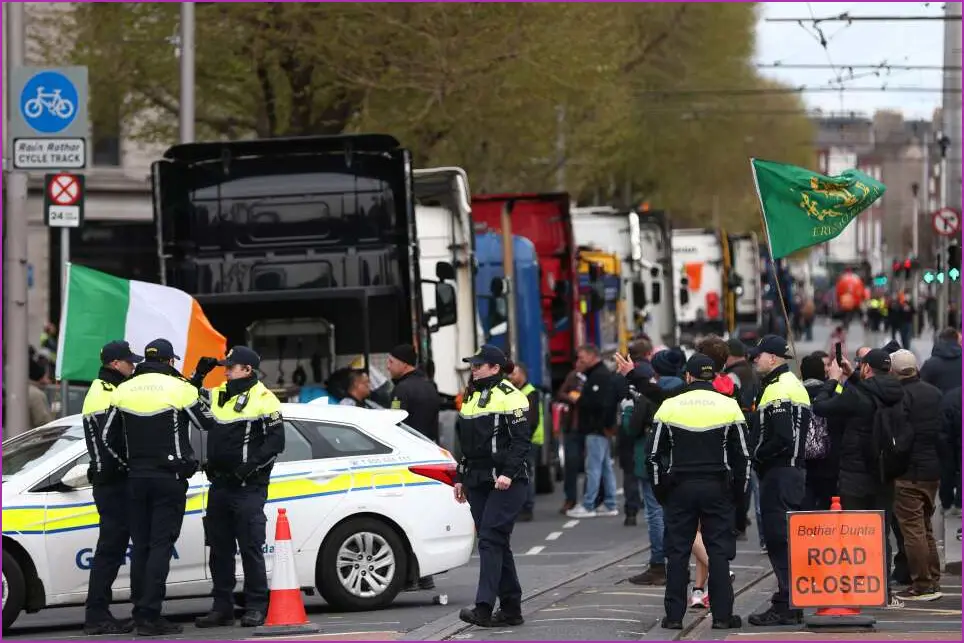
DUBLIN (AP) — On Saturday, police intervened to disperse protesters at Ireland’s only oil refinery, aiming to restore operations after a series of demonstrations that had been ongoing for five days. The protests, triggered by surging fuel prices, left many gas stations empty and threatened to disrupt transportation nationwide.
Access to critical fuel depots and a key port was obstructed by trucks and tractors, leading to traffic congestion that affected parts of Dublin’s main highway and other major routes.
Irish Police Commissioner Justin Kelly stated that actions would be intensified as the protests were illegally blocking essential infrastructure, posing risks to public safety amid gas shortages that could hinder emergency services. “These are not legitimate protests; they are blockades,” Kelly remarked, noting that police had warned protesters about enforcement actions.
Push for Fuel Price Caps
Government representatives and negotiators indicated progress was made in discussions on Saturday to address the situation. Ger Hyland, president of the Irish Road Haulage Association, conveyed understanding for the protesters’ concerns, describing them as hardworking individuals striving to keep their businesses viable.
The protests commenced on Tuesday and escalated, fueled by social media, drawing in truckers, farmers, and operators from the taxi and bus sectors demanding price caps or tax reductions on fuel.
Officials, who had already implemented measures to mitigate rising prices, expressed confusion over the reasoning behind the protests, attributing the global price hike to the ongoing conflict in the Middle East, which has affected oil exports. Prime Minister Micheál Martin cautioned that Ireland could soon be forced to turn tankers away due to the global shortage.
Fuel Shortages at Service Stations
More than a third of the 1,500 service stations were reported to be out of fuel on Saturday, with expectations that this number would increase if blockades continued. Restoring service at the Whitegate refinery in County Cork was seen as a potential solution.
Police units arrived at the refinery to remove protesters, utilizing pepper spray during the operation, while military support was on standby. Although arrests were made, specific figures were not provided. A convoy of fuel trucks was escorted to load up at the refinery and later seen leaving, alongside footage of tankers departing from a fuel hub after being allowed through by protesters.
Despite recent government actions to lower fuel taxes and assist low-income households with heating costs, rising international prices quickly diminished the impact of these measures. The protests initially involved slow-moving vehicles blocking significant streets in Dublin and fuel depots, with some participants spending the night in their vehicles, demanding governmental discussions.
Supporters of the protests gathered on Dublin’s streets, while tractors moved slowly through Cork. The route to Rosslare Europort, an essential freight and passenger ferry entry point, was also blocked, risking saturation of the port by Sunday, as mentioned by Harbormaster Tom Curran.
