



The enforcement of track limits has been a longstanding issue in Formula 1 races, generating considerable debate among fans and drivers alike.
Drivers often test the boundaries of acceptable limits to improve their lap times and are quick to point out other competitors they believe have overstepped these limits. Moreover, they frequently dispute claims of their own violations.
Teams typically support their drivers, leading to extensive discussions that can delay race results. For instance, at the 2023 Austrian Grand Prix, the FIA had to evaluate over 1,000 suspected track limit breaches, highlighting the growing necessity for more advanced tools to expedite this process.
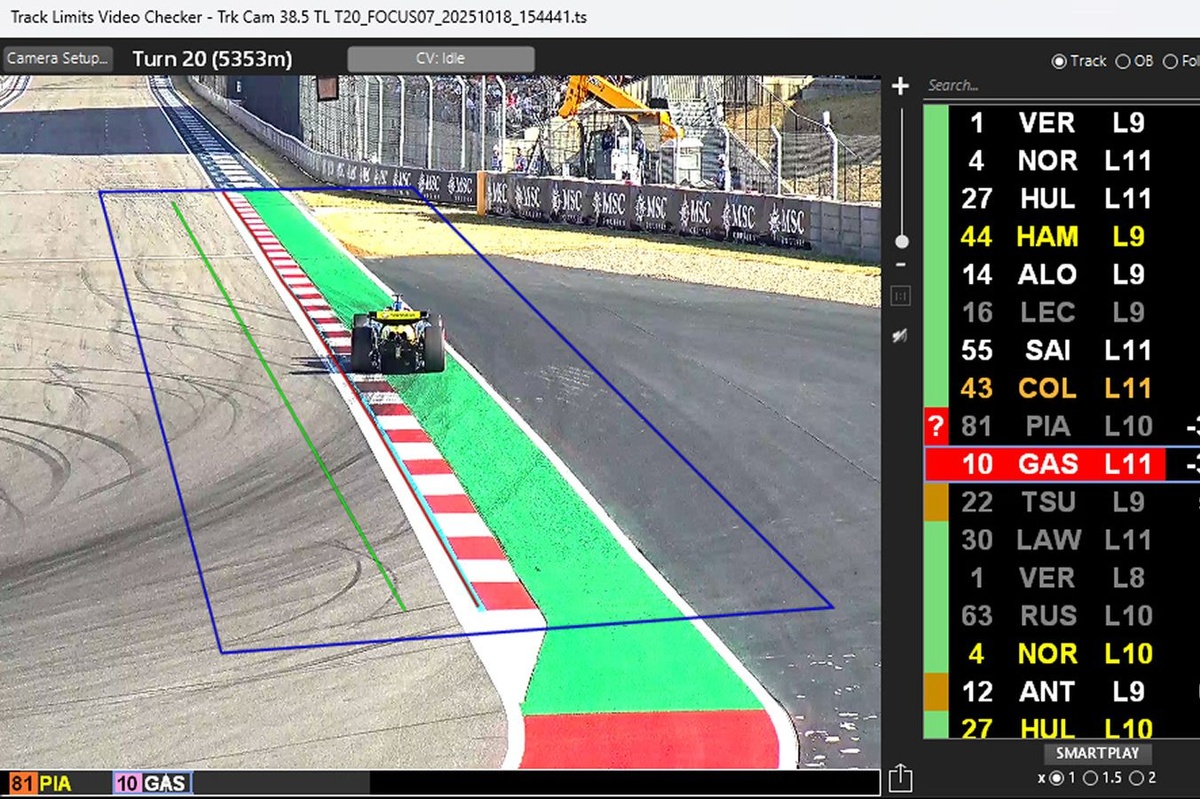
To address these challenges, the FIA collaborated with Catapult to develop an automated system for detecting when cars cross the white lines, incorporating it into RaceWatch, the tracking software used by race control. This new system significantly aids stewards by rapidly identifying potential infractions, allowing for notifications to teams within seconds. According to the FIA, this computer-vision tool has reduced the number of cases requiring human judgment by 95%.
Enhanced Transparency and Functionality
The integrated computer-vision technology in RaceWatch can recognize car shapes and analyze their movements against established reference points. Looking towards 2026, the FIA plans to enhance functionality by providing teams with footage of any track-limit violations by their drivers. This improvement will foster greater transparency and minimize disputes, leading to quicker workflows and feedback for teams.
Advancements in Data Processing
Another notable enhancement involves a more sophisticated detection system that redefines the data analysis process. By employing high-performance GPUs, the recognition process will be conducted in real-time, improving both accuracy and speed in verifying lap details.
Distributed Processing Capabilities
The new system features a centralized camera controller that facilitates distance measurements from a single point and distributes processing tasks across the network. Chris Bentley, the FIA’s Single Seater Head of Information Systems Strategy, emphasized that this innovation allows for a more efficient data handling process.
Towards a More Data-Driven Approach
Thanks to recent innovations, the FIA can now track a vehicle’s position with high precision, using multiple data sources. The new approach not only relies on coordinates but also incorporates timing data and racing line information to effectively create a real-time ‘digital twin’ of track activities.
Introducing the ECAT System
The new “Every Car All Turns (ECAT)” concept will analyze a car’s behavior against a reference model. By correlating this data with sector timing, RaceWatch will accurately detect potential track limit breaches, allowing for quicker assessments and reducing the reliance on manual review.
The system can now identify infringements based on positioning data alone. Alerts can be triggered by unusual deviations from the ideal racing line or by entry into designated virtual zones. As data-driven decision-making becomes the norm, it is hoped that ongoing discussions about track limits will diminish.
