



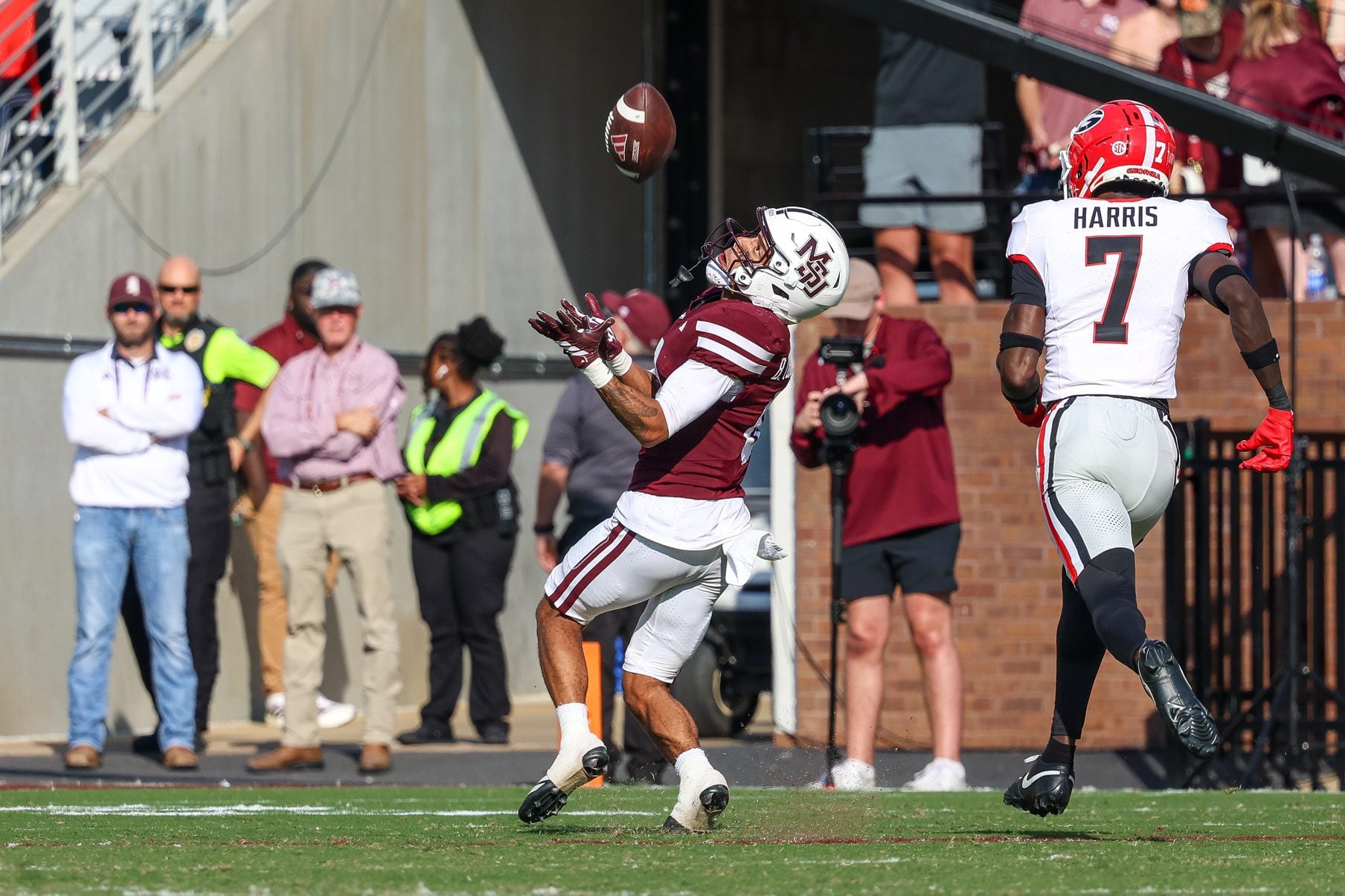
Experts, both locally and nationally, agree on the Chicago Bears‘ draft priorities. Aside from focusing on the left tackle, the main objective is to revamp the defense, which currently ranks 29th. Many key players are set to enter free agency, while others, like Tremaine Edmunds and Gervon Dexter, could potentially be traded. Although the team addressed tight end and wide receiver in the previous year’s draft, it’s important to remember that Bears head coach Ben Johnson has the final say.
It’s important not to exclude wide receiver as a draft option this April, and for reasons beyond what you might think. While D.J. Moore has faced trade rumors due to a decrease in his production last year, his situation won’t be the primary reason for Johnson’s desire to secure another pass catcher. The motivation is much simpler.
Johnson seeks to enhance the team’s speed.
Ben Johnson’s Pursuit of Speed at Every Position
This became apparent in the 2022 and 2023 drafts while he was the offensive coordinator for the Detroit Lions. The Lions took Alabama receiver Jameson Williams in the 1st round despite his recovery from a torn ACL, drawn in by his incredible speed estimated in the 4.2-4.3 range. The following year, they picked running back Jahmyr Gibbs in the 1st round, who clocked a 4.36 at the scouting combine. Both players proved to be pivotal in Johnson’s offense over the ensuing seasons.
Looking at the current Bears’ offensive lineup, they lack a player who poses a genuine deep threat. The closest option is Luther Burden, who ran a 4.41 and was the team’s top vertical threat last season, but he doesn’t excel at stretching the field. To effectively utilize his system relying on the run and play-action, Johnson will need someone who can force defenses into a two-high safety alignment. The 2026 draft class appears to have ample choices in that regard.
Key Talents Available in Later Rounds
Don’t expect Johnson to make a move in the early draft rounds; the focus for the first few rounds will likely be defense and left tackle. Nevertheless, day three should get interesting. The 4th or 5th rounds could be ideal for taking a risk. Based on current projections, some top names mentioned could still be accessible in that range. Players like Thompson might be drafted in the 3rd or 4th, while Caldwell could fall somewhere between the 3rd and 5th rounds.
Much will depend on Johnson’s preferences. Historically, every wide receiver he has picked since 2016 has been at least 6’0″ tall. If that trend continues, Caldwell, standing at 6’5″ with a 4.31 time, becomes a name to watch. Although his route running requires refinement and he only started one season at the FBS level, this may explain why he could be available on day three.
The Importance of Speed in Today’s NFL
Johnson recognizes that speed is crucial to winning in the modern NFL. His extensive analysis of the game has kept him informed about emerging trends. Notably, many recent Super Bowl champions have featured at least one fast wide receiver in their passing game. Since 2000, 12 of the championship teams had a player with sub-4.40 speed. While it’s not the sole factor in determining champions, it significantly contributes.
The Bears’ history reinforces this concept. Their last title came in 1985, when Willie Gault, known for his 4.2 speed, was the leading target. Johnny Morris, the franchise’s all-time leading receiver from the 1963 championship, was a world-class sprinter with a time equivalent to 4.16 seconds today. It’s no coincidence that the Bears last reached a conference championship with Johnny Knox in their lineup.
Speed is irreplaceable in football, and Johnson is unlikely to overlook this in the draft.
