



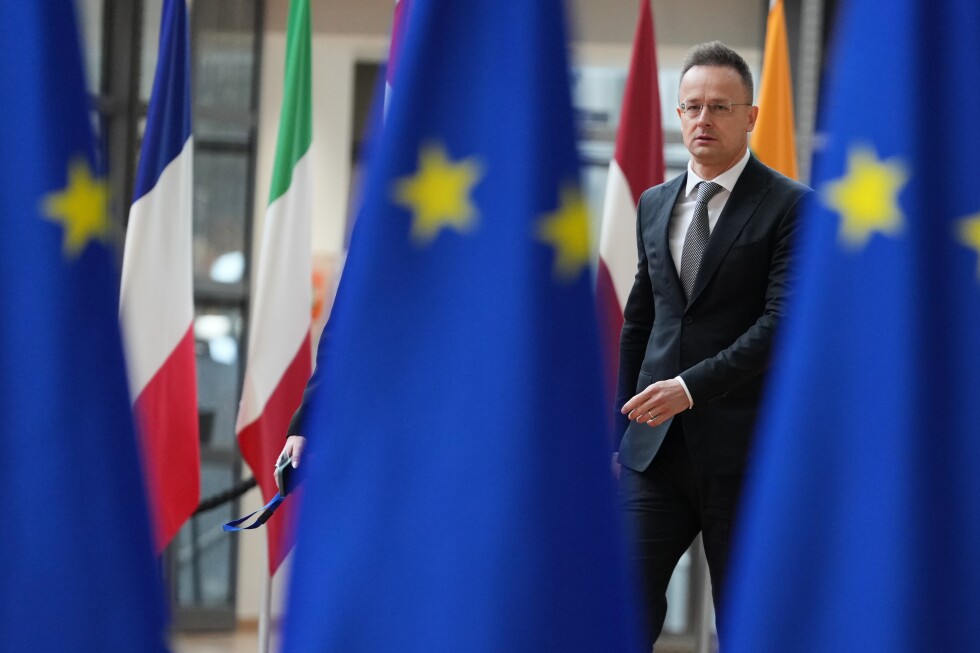
BRUSSELS (AP) — The European Union was unable to implement new sanctions against Russia on Monday due to unexpected opposition from Hungary, according to the bloc’s chief diplomat.
Kaja Kallas, the EU’s foreign policy chief, expressed disappointment, stating, “This is a setback and a message we did not want to send today.” EU foreign ministers had been working to finalize sanctions alongside a significant new loan for Ukraine before the fourth anniversary of the war, which has resulted in approximately 1.8 million Russian and Ukrainian soldiers dead, injured, or unaccounted for.
The meeting aimed to impose increased economic penalties on Russia for its ongoing aggression that began on February 24, 2022.
Hungary, noted as the EU’s most pro-Russian state, threatened over the weekend to hold up both the new sanctions and a proposed 90 billion euro ($106 billion) loan designated to support Ukraine’s military and economic needs for the forthcoming two years.
At a pro-Ukrainian event in Berlin, German Chancellor Friedrich Merz characterized the day as marking “four monstrous years of war.” He urged European partners to maintain robust support for Ukraine, stating, “We are standing at a crossroads that could determine the well-being of our entire continent.”
French President Emmanuel Macron emphasized that “our determination to support Ukraine is unwavering” during discussions with Finnish President Alexander Stubb, who reiterated the need for European allies to increase pressures on Russian President Vladimir Putin.
Addressing Hungary’s Resistance
Several EU leaders aimed to advance the 20th package of sanctions targeting Russia’s shadow fleet and energy revenues before Tuesday’s war anniversary.
However, Hungary declared its intent to remain steadfast until Russian oil deliveries to the country resume. Although Hungary initially consented to the loan to Ukraine, Kallas noted that retracting this commitment contradicts EU treaties.
Oil shipments from Russia to Hungary and Slovakia have been suspended since January 27, due to damage to the Druzhba pipeline from Russian drone strikes, which transports Russian crude via Ukrainian land to Central Europe.
Hungarian Prime Minister Viktor Orbán reiterated a claim that Ukraine is intentionally obstructing Russian oil shipments and accused Kyiv of attempting to undermine his government. He referred to these interruptions as a “Ukrainian oil blockade” orchestrated by President Volodymyr Zelenskyy.
Increasing Pressure on Russia
Some European leaders highlighted that elevating the costs for Russia is the most effective means to encourage peace in Ukraine. Merz stated, “This war will end only when Russia no longer sees value in continuing it, when it cannot anticipate further territorial acquisitions, and when the costs of this madness have escalated too high.”
Finland’s leadership conveyed that Russia’s actions represent a “strategic failure,” arguing for heightened pressure on Putin, emphasizing, “It is also a military failure — he is now losing many soldiers — and, additionally, it is an economic failure.”
So far, the EU has provided Ukraine with 194.9 billion euros ($229.8 billion) in financial aid while simultaneously targeting Russia’s critical energy exports. Many European states have significantly reduced or entirely ceased Russian energy imports since the onset of the full-scale war in Ukraine; however, Hungary and Slovakia have upheld and even amplified their imports of Russian oil and gas, receiving a temporary exemption from an EU ban on Russian oil imports.
The Political Landscape in Hungary
As Hungary nears a significant election in under two months, Orbán has initiated an aggressive anti-Ukraine campaign, accusing the opposing Tisza party, currently leading in polls, of colluding with the EU and Ukraine to establish a “pro-Ukraine government aligned with Brussels and Kyiv.”
Poland’s Foreign Minister Radosław Sikorski suggested that Hungary’s threat of a veto might be driven by Orbán’s struggle to retain his hold on power as he faces the most significant challenge since assuming office in 2010.
“I expected a much stronger sense of solidarity from Hungary for Ukraine,” Sikorski remarked in Brussels, pointing to the ruling party’s efforts to cultivate hostility towards Ukraine, which it appears to be leveraging for electoral purposes, deeming this situation quite shocking.
___
Corbet reported from Paris. Associated Press writers Justin Spike in Budapest and Geir Moulson in Berlin contributed to this report.
