



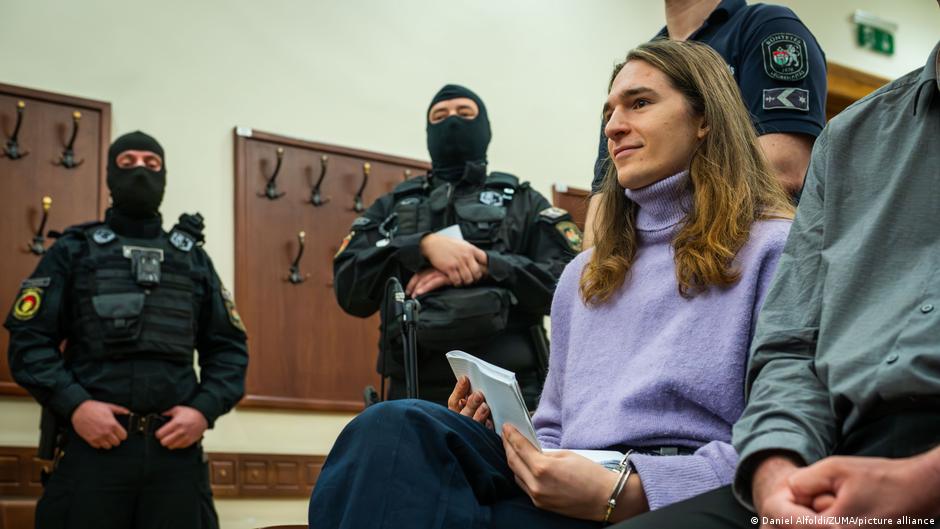
On Wednesday, a Hungarian court found Maja T.*, an anti-fascist activist from Jena in the eastern German state of Thuringia, guilty of inflicting serious injuries on several suspected right-wing extremists in Budapest in February 2023. The attacks appeared to target individuals associated with the annual “Day of Honor” rally for neo-Nazis from across Europe, held in the Hungarian capital.
The indictment stated that the 25-year-old German was convicted of attempted grievous bodily harm and involvement in a criminal organization. The verdict is not yet final and can still be appealed within Hungary’s legal system.
The Hungarian prosecution had initially sought a 24-year prison sentence as a means of deterrence. They argued that T. was part of a left-wing extremist faction comprising 19 members who assaulted nine people, causing broken bones and head injuries.
Human Rights Concerns
There were both legal and political implications surrounding T.’s trial in Budapest.
In June 2024, T. was extradited from Germany to Hungary and subsequently placed in solitary confinement while on trial. However, Germany’s Federal Constitutional Court ruled that the trial should not have occurred in Hungary, citing the European Union Charter of Fundamental Rights, which prohibits inhumane treatment.
The court noted that adequate checks were not performed before T.’s extradition to ensure humane conditions of detention in Hungary, particularly since Maja T. identifies as non-binary.
Since 2021, Hungary has implemented legislative changes targeting LGBTQ+ individuals. In early 2025, under Viktor Orban’s administration, laws were passed that could be used to ban Pride parades and similar events.
Maja T. frequently reported poor hygiene conditions, inadequate food, extreme temperatures, and issues with lighting and ventilation in the cell, among other grievances. In summer 2025, T. undertook a 40-day hunger strike in an unsuccessful attempt to improve prison conditions.
Politicians from Germany’s Social Democrats, Green Party, and Left Party have supported Maja T.’s repatriation to Germany and urged Chancellor Friedrich Merz and the German government to exert pressure on Hungary. Following the verdict, Maja T.’s father described the trial as politically motivated, aimed at rallying support for Orban ahead of upcoming parliamentary elections. Martin Schirdewan, co-chair of the Left group in the European Parliament, echoed this sentiment, calling the judgment “disproportionate.” Meanwhile, Hungary classified the German group “Antifa East,” to which Maja T. is allegedly linked, as a terrorist organization in 2025. In contrast, right-wing extremists continue to gather freely, as demonstrated by the upcoming “Day of Honor” celebration on February 14.
*Editor’s note: DW adheres to the German press code, emphasizing the protection of the privacy of suspected criminals or victims by avoiding the disclosure of full names in such cases.
This article was translated from German.
While you’re here: Every Tuesday, DW editors compile updates on German politics and society. You can subscribe here for the weekly email newsletter, Berlin Briefing.
