



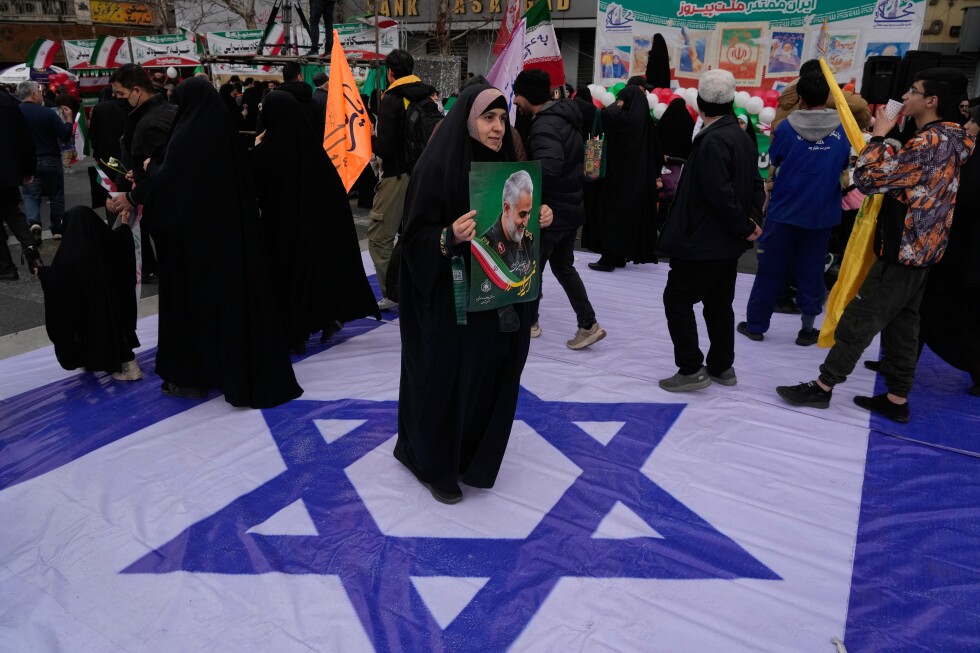
DUBAI, United Arab Emirates (AP) — Iran observed the 47th anniversary of its 1979 Islamic Revolution on Wednesday amid ongoing pressures from U.S. President Trump, who has suggested deploying another aircraft carrier group to the Middle East, and a public outraged by Tehran’s violent response to nationwide protests.
The commemorative events highlighted a stark duality in Iran, with state television broadcasting images of hundreds of thousands participating in pro-government demonstrations, featuring the burning of American flags and chants of “Death to America!” In contrast, the night prior, celebratory fireworks were accompanied by chants of “Death to the dictator!” from Tehran homes.
During his address at Azadi Square in Tehran, President Masoud Pezeshkian asserted Iran’s readiness to negotiate over its nuclear program as preliminary talks with the U.S. remain uncertain.
The potential success of these negotiations is still in question, raising concerns among Middle Eastern nations that a failure could lead to regional conflict. A senior Iranian security official met with Qatar’s foreign minister in Doha on Wednesday after previously visiting Oman, which has played a mediating role in the current dialogue.
In his speech, Pezeshkian stated that Iran is “not pursuing nuclear weapons” and is “open to any verification.” However, the International Atomic Energy Agency has been unable to inspect Iran’s nuclear inventory for months. He claimed, “The extensive mistrust created by the U.S. and Europe prevents a resolution to these talks,” while emphasizing Iran’s commitment to regional peace.
Commemoration Overshadowed by Repression
State television aired footage of pro-theocracy protests in Iran to honor the regime and Supreme Leader Ayatollah Ali Khamenei, alongside critiques of Reza Pahlavi, the exiled crown prince advocating for anti-government demonstrations. Participants expressed solidarity with their leader against perceived threats from the U.S. and Israel.
Exhibits of Iranian missiles and debris purportedly from downed Israeli drones were displayed, alongside symbolic coffins covered with the American flag. While many Iranians participated in government-sponsored events, their involvement often stemmed from being government employees or seeking the celebratory atmosphere. The notable oppression of protests last month, which left thousands dead and many more detained, has made attendees cautious. One Tehran resident commented, “How can I participate now when the streets were stained with blood last month?”
Diplomatic Engagement Amid Tension
As festivities unfolded, Ali Larijani, a senior Iranian security official, held discussions in Qatar with Foreign Minister Sheikh Mohammed bin Abdulrahman Al Thani. Larijani also engaged with the Palestinian Hamas group and the Iran-backed Houthi rebels in Oman. He disclosed that there was no specific proposal from the U.S. during his visit but acknowledged some “message exchanges.”
Highlighting concerns about potential U.S. actions, Iranian Foreign Minister Abbas Araghchi told RT that Tehran still lacks complete trust in the U.S., referencing past negotiations that led to military aggression against Iran. Nevertheless, he indicated that a superior deal might be achievable compared to the 2015 agreement, which the Trump administration abandoned.
U.S. Military Posturing
The United States has sent the USS Abraham Lincoln and other naval assets to the region to exert pressure on Iran and signal readiness for potential military action. Recently, U.S. forces downed a drone deemed a threat near the Lincoln while responding to Iranian attempts to obstruct U.S.-flagged vessels.
Trump has suggested the possibility of deploying an additional carrier to the area, noting, “We have another armada potentially heading there.” The specific carrier to be utilized is still uncertain, with the USS George H.W. Bush departing Norfolk and the USS Gerald R. Ford remaining in another operational region.
U.S. Vice President JD Vance, during a visit to Baku, Azerbaijan, reiterated a focus on negotiating agreements, while also leaving open the possibility of alternative actions if discussions falter. “We maintain the strongest military in the world and have numerous options available,” he remarked.
