



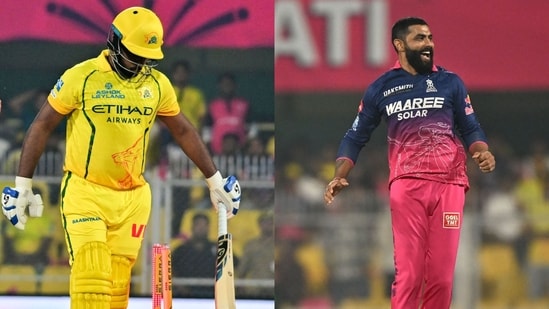
The official trade document shows that Chennai Super Kings acquired Sanju Samson for ₹18 crore, while Rajasthan Royals secured Ravindra Jadeja, whose fee was adjusted from ₹18 crore to ₹14 crore as part of the deal. In a match held in Guwahati, Samson scored 6 runs off 7 balls, CSK struggled early at 41/4 during the powerplay, and ultimately got bowled out for 127. Jadeja took 2 wickets for 18 runs in 3 overs, leading RR to win by 8 wickets with 47 balls remaining. The trade was finalized in November, and the first financial report was released on March 30.
When analyzing the match-impact rather than just the scorecard, the disparity becomes stark. Teams do not invest ₹18 crore merely for runs or wickets; they pay for game control, fulfilling roles, and the ability to change match dynamics. By this measure, Samson and Jadeja had not only different performances; they represented contrasting outcomes of the same trade.
The Method Behind the Number
The simplest way to evaluate a match is to calculate the per-game cost based on the season fee. For a 14-match league, Samson’s ₹18 crore comes to approximately ₹1.286 crore per match, while Jadeja’s ₹14 crore equals ₹1 crore per game. This illustrates the cost aspect of the trade.
However, value must be role-adjusted. An opener in the powerplay on a damp pitch has a different job than a lower-order batsman entering at 120/3 on a flat surface. Similarly, a spinner bowling at 51/4 is not in the same situation as one bowling at 180/3. Thus, the model should reward effective contributions in critical moments and penalize failures in pivotal positions.
Samson’s Side of the Ledger
In a role-adjusted batting framework, Sanju Samson’s 6 off 7 is not just a poor return; it is categorized as a negative impact. He faced high-risk conditions, failed to navigate movement effectively, and left CSK vulnerable before the innings had properly formed. After the sixth over, CSK was at 41/4, and by the seventh over, following Jadeja’s strike, they were at 57/6. Thus, Samson’s effort is not just a regression but an opening-phase deficit.
Jadeja’s Side of the Ledger
Conversely, Ravindra Jadeja’s performance was impactful. Though CSK was struggling, a recovery was still plausible at 38/4. Jadeja dismissed Sarfaraz Khan and Shivam Dube, leaving CSK reeling at 57/6 when they were attempting to stabilize. His figures of 3-0-18-2 show that he didn’t just diminish CSK’s total but also made RR’s chase easier by reducing the target early on.
What CSK Lost in the Trade
Combining both performances suggests a difference of roughly ₹2.58 crore in favor of RR for this match alone. This illustrates that Chennai spent more and received significantly less, while Rajasthan paid less and gained a greater impact on the game. To put this in perspective, ₹2.58 crore could buy around 188 Royal Enfield Hunter 350 bikes or about 215 MacBook Airs, emphasizing the stark contrast between the trade’s value and the game’s outcome.
