



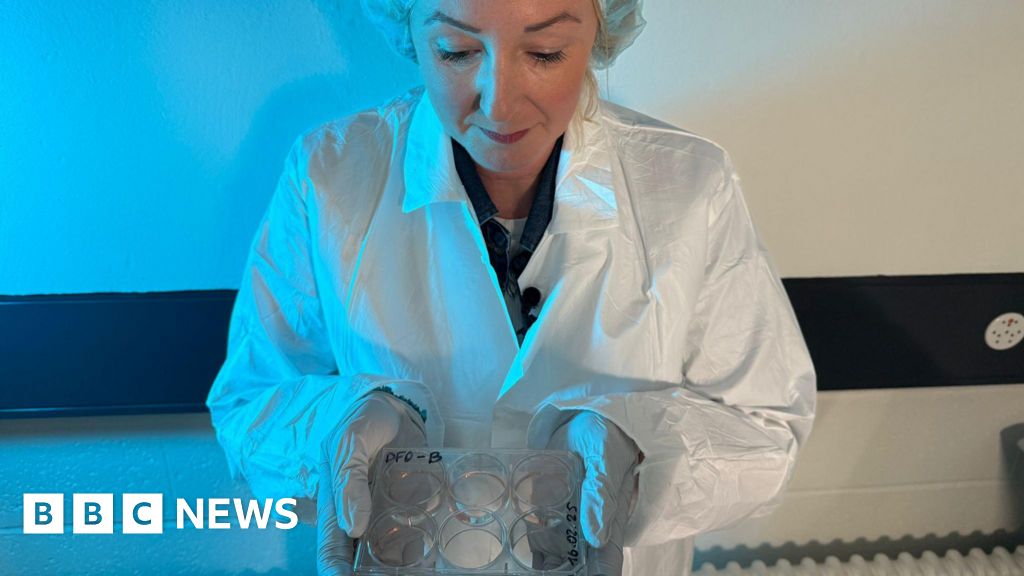
Zoe Kleinman, Technology Editor
While the idea may stem from sci-fi, a select group of researchers are making strides in developing computers from biological cells.
Welcome to the unconventional domain of biocomputing.
A collaborative team of scientists in Switzerland, whom I visited, is at the forefront.
They envision a future where data centers house “living” servers, mimicking the cognitive processes of artificial intelligence (AI) and potentially utilizing significantly less energy than contemporary systems.
Dr. Fred Jordan, co-founder of the FinalSpark lab I explored, shares this vision.
We are familiar with hardware and software in our current computers. However, Dr. Jordan and his colleagues refer to their work as “wetware”.
This concept revolves around developing neurons that form clusters known as organoids, which can be connected to electrodes, allowing them to function similarly to mini-computers.
Dr. Jordan understands that the concept of biocomputing may be perplexing to many.
“In science fiction, these ideas have been explored for quite a while,” he noted.
“Describing a neuron as a small machine reshapes our understanding of our own brains, provoking reflection on our identity.”
At FinalSpark, the path begins with stem cells sourced from human skin, acquired through an anonymous clinic in Japan, though the team receives numerous offers from prospective donors.
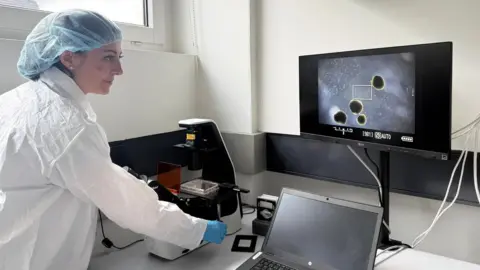
During my lab visit, Dr. Flora Brozzi presented a dish filled with small, white spheres.
These spheres are essentially miniature, lab-grown brains made of living stem cells that have developed into neuron clusters – the “organoids”.
While they don’t rival the complexity of a human brain, they contain the essential components.
After several months of nurturing, the organoids can be linked to electrodes to respond to basic keyboard commands.
The challenge of sustaining a biocomputer is far more complex than that of a standard computer, which simply requires a power source.
According to Simon Schultz, a neurotechnology professor at Imperial College London, “Organoids lack blood vessels, essential for nutrient supply like those in the human brain.”
Despite having achieved organoids that survive for up to four months, there remain unanswered questions about their eventual decline, with observable bursts of activity before they cease functioning.
