



Certainly! Here’s a paraphrased version of the article in HTML format:
<section class="recurrent-blocks recurrent-newsletter-block">
    <div class="container newsletter-container">
        <div class="newsletter-content">
            <h2 class="newsletter-cta-title"> </h2>
            <p class="article-paragraph skip">Join us to witness innovations that shape the future.</p>
            <div class="newsletter-cta-description">
                <p class="article-paragraph skip">Discover groundbreaking advancements from the forefront of science and technology.</p>
            </div>
        </div>
    </div>
</section>

<p class="pw-incontent-excluded article-paragraph skip">In 2022, Cortical Labs, an Australian biotech startup, made headlines by <a target="_blank" href="https://www.npr.org/sections/health-shots/2022/10/14/1128875298/brain-cells-neurons-learn-video-game-pong" rel="noreferrer">announcing</a> their achievement in training “mini-brains” composed of 800,000 to one million human brain cells cultured in a petri dish to play the classic video game “Pong.”</p>

<p class="article-paragraph skip">Brett Kagan, the chief scientific officer of Cortical Labs, stated, <a target="_blank" href="https://www.newscientist.com/article/2301500-human-brain-cells-in-a-dish-learn-to-play-pong-faster-than-an-ai/" rel="noreferrer"><em>New Scientist</em></a> noted at the time, “The most impressive part is the speed of learning, as it happens in just five minutes.”</p>

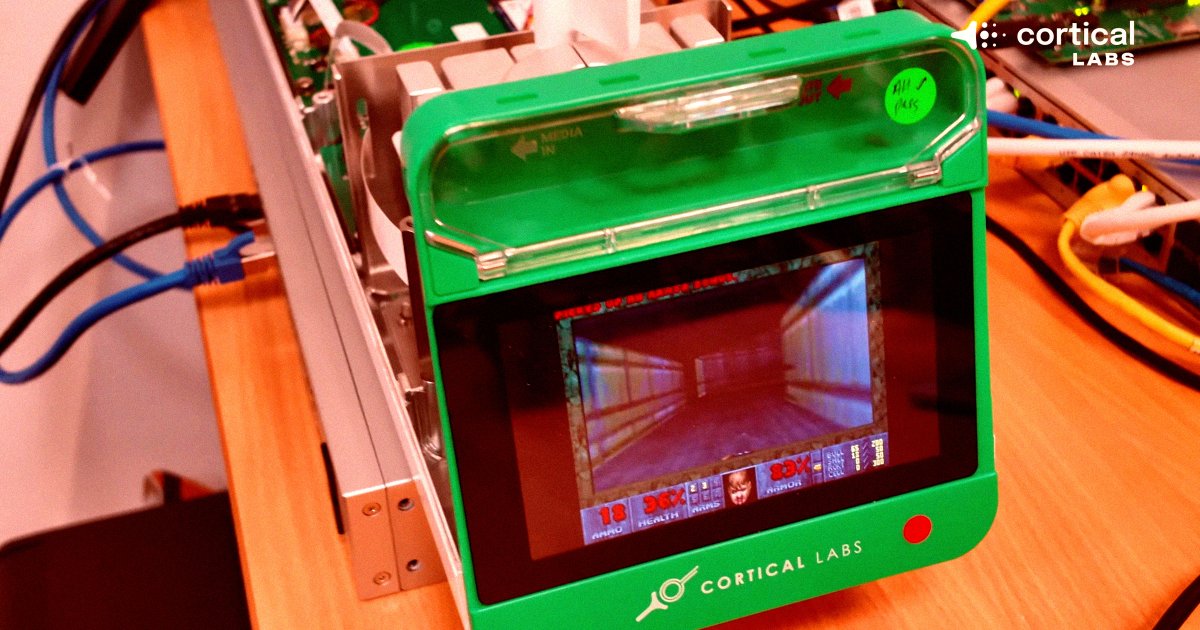
<p class="article-paragraph skip">Almost a year after introducing the CL1, touted as “the world’s first code-deployable biological computer,” the company made a bold claim. They announced that they had trained living human brain cells to play the more complex and three-dimensional game “Doom,” showcasing the advancements made over the past four years.</p>

<p class="article-paragraph skip">The concept of playing “Doom” has become a cultural meme, with instances of the game being played in unusual settings like <a target="_blank" href="https://futurism.com/space/hacker-doom-satellite-esa">satellites in space</a>, on <a target="_blank" href="https://futurism.com/neoscope/doom-runs-on-e-coli">E. coli bacteria</a>, and even within <a target="_blank" href="https://futurism.com/the-byte/run-doom-inside-doom">another version of Doom</a>.</p>

<p class="article-paragraph skip">Kagan explained in the announcement that proving biological neurons could play “Pong” was a monumental achievement, showcasing adaptive learning in real-time. This initial feat took 18 months of refining their equipment, while “Doom,” being significantly more intricate, posed a greater challenge.</p>

<p class="article-paragraph skip">To enable the CL1 to operate “Doom,” the team translated the digital game world into electrical signals, allowing the neural culture to respond and interact, as noted by CTO David Hogan. Despite their current skill level being akin to beginners, the brain cells have demonstrated the capability to target enemies and navigate the game.</p>

<p class="article-paragraph skip">While the neurons' performance isn't particularly proficient at this stage, Kagan expressed aspirations for further development, aiming for their neurons to excel in “Doom” and tackle even more complex tasks in the future. Reactions from the gaming community have varied, with some expressing awe and others humorously commenting on the implications of this biological achievement.</p>
This maintains the core information while providing a structured HTML format with appropriate headings and paragraphs.
