



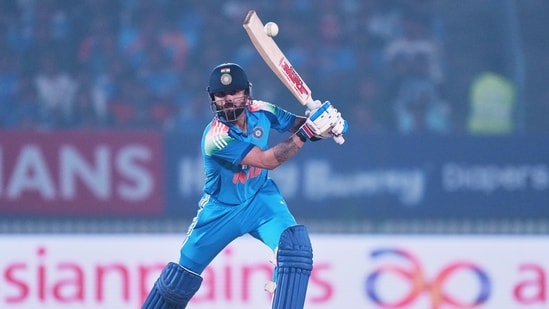
Virat Kohli’s “dominance” in the ICC men’s ODI batting rankings can be evaluated through two distinct lenses: longevity and separation. Longevity refers to how long one remains at No. 1, while separation indicates the lead one holds over the next-best batter. Kohli’s longest tenure at the top lasted from October 22, 2017, to April 1, 2021, which highlights endurance. However, the period where he truly stood apart from the competition was early 2018, when the gap between him and the rest resembled a chasm rather than a simple leaderboard.
The early-2018 period exemplifies a No. 1 ranking that felt secure. Kohli wasn’t just consistent; he built an insurmountable cushion, ensuring that even strong performances from the No. 2 batter couldn’t jeopardize his position.
Understanding “way ahead” in ICC rankings
Rankings aren’t merely a tally of runs; they reflect recent performance over a rolling window, emphasizing that consistent high-impact contributions are more significant than one outstanding game. Therefore, a lead can’t be established by a single extraordinary innings. Instead, one must accumulate numerous high scores to create a gap that’s challenging to close.
In top rankings, gaps often narrow since elite batters frequently stay close to one another, making small changes in form capable of swapping positions. Thus, a significant points gap at No. 1 is notable, indicating not only who is best but also how challenging it is for the second-best to catch up without consistent superior performance.
The peak of separation: February 2018
Kohli’s most remarkable separation came after India’s ODI series in South Africa in February 2018, where he attained 909 rating points, establishing a 65-point lead over second-placed AB de Villiers.
A 65-point difference at the top is substantial; it signifies not just current status but also the resilience of that position against other strong contenders. Kohli’s performance during that series was impressive: 558 runs from six ODIs with three centuries, showcasing consistency with scores of 112, 46 not out, 160 not out, 75, 36, and 129 not out.
Why the South Africa series was significant
In ODI analysis, context dictates the impact of a batter’s dominance. Scoring heavily in South Africa—a challenging venue—reflects real ability. Kohli’s runs were not just accumulation; they were authoritative. His innings included a commanding 160 not out, demonstrating both scoring capacity and control, thereby shaping his lead in the rankings.
The verdict
Kohli’s 1,257-day reign at No. 1 from October 2017 to April 2021 showcases sustained supremacy. However, early 2018 signifies the peak of visible dominance, where Kohli led the rankings in a manner that made it seem like the competition was striving uphill while he was on a smooth pathway.
