


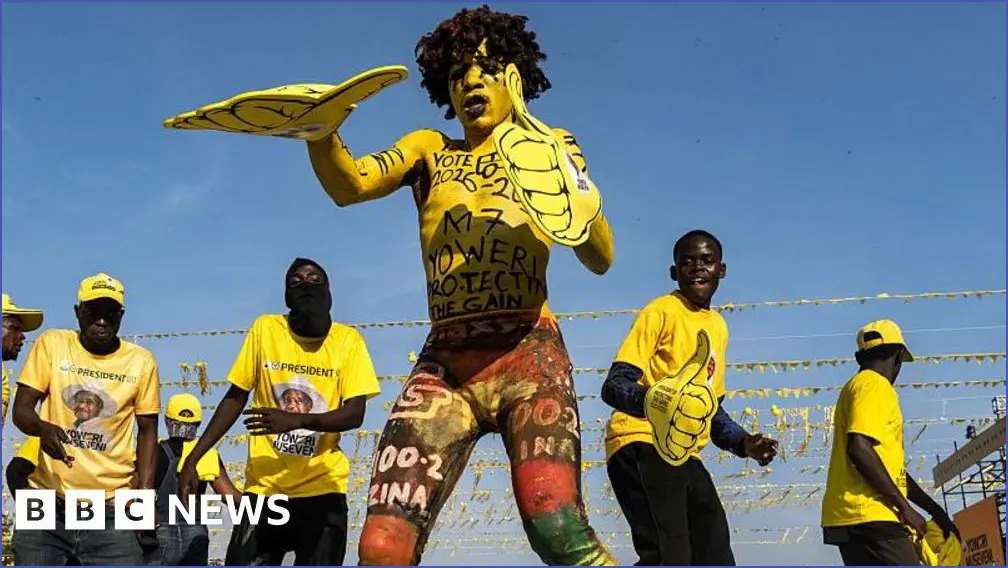
Uganda’s President Museveni Claims Electoral Victory
Author: Sammy Awami, BBC Africa, Kampala
A Resounding Win
Supporters of Uganda’s President Yoweri Museveni view his recent election victory as a testament to his four-decade-long leadership. Museveni secured 72% of the votes, aligning closely with his previous high of 74% achieved in Uganda’s inaugural direct presidential election in 1996.
Opposition Reaction
Despite Museveni’s triumph, his principal opponent, the charismatic former pop star Bobi Wine, has dismissed the election results as “fake.” Wine claims to have gone into hiding following a raid on his residence by security forces.
Campaign Promises
Museveni emphasized his experience during his campaign, asserting that he has brought political and economic stability amid global uncertainties. He vowed to lead Uganda toward achieving middle-income status by 2030, leveraging the country’s emerging oil industry as a cornerstone for this goal.
Concerns About Health and Public Perception
Despite his age, Museveni aimed to appear vigorous and in control. However, his campaign faced interruptions as several events were abruptly cancelled for unspecified “state duties,” raising questions about his health and stamina amid speculation of fatigue.
Challenges for Bobi Wine
For Bobi Wine, the election outcome marked a significant setback, with his vote share dropping from 35% in 2021 to 25% this time. He criticized the election’s credibility, citing security forces’ disruptions at his rallies and claims of ballot stuffing, though no evidence has been presented.
Future of Political Change
As Uganda contemplates its future, questions about Museveni’s eventual succession loom large. According to journalist Allan Kasujja, political changes in Uganda are gradual rather than sudden. He suggests that the recent elections merely legitimize ongoing shifts within the ruling National Resistance Movement (NRM) party.
Shifts Within the Ruling Party
The recent elections in the NRM highlight an increasing influence of army chief Gen. Muhoozi Kainerugaba, Museveni’s son. The reshuffling of party leadership indicates a focus on succession dynamics rather than genuine political competition. Decision-making appears more centralized within a close inner circle surrounding the president, suggesting a growing military influence in Uganda’s political landscape.
