


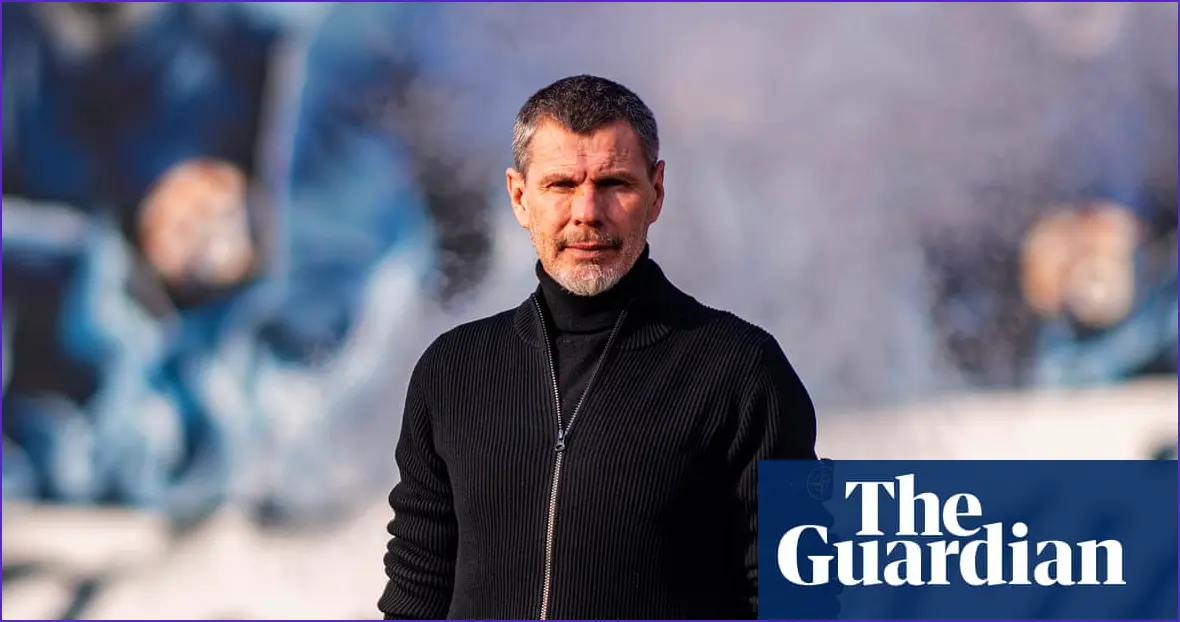
A thick afternoon mist envelops Stadion Maksimir, accentuating its striking architecture. Nearby, Zvonimir Boban shares his reasons for returning. While enjoying squid ink risotto in a space now serving as Dinamo Zagreb’s canteen, he reflects on his past, recalling where he once slept as a youth player from Dalmatia. “Emotionally it’s the biggest story of my life,” Boban reveals, nostalgic about his formative years at the club. “Where, if not here?”
Boban has had a significant impact on football, particularly during his time in high-level roles at Fifa and Uefa over the last decade. After his notable resignation from Uefa nearly two years ago, he sensed he still had more to achieve. Ironically, his influence has both diminished and expanded, lacking the administrative power he held in Switzerland, yet taking on the intense scrutiny that comes with being Dinamo’s president. Recent comments in the media following a 3-1 Europa League loss to Real Betis illustrate this scrutiny. “They say Jesus was a good man,” he reflects, “so who are we not to be crucified in our daily lives?”
Boban’s personality is marked by rhetorical strength. He stepped back into Dinamo six months ago and quickly rose from CEO to president in the club’s first fully democratic election. His mission is to overhaul the institution still suffering from the fallout of past scandals linked to former CEO Zdravko Mamic. Notably, he takes on this challenge without any salary.
“Throughout my life, I’ve professed my love for Dinamo, for the people, the city, and my country,” he emphasizes. “When given this opportunity, would I really say, ‘No, I’m 57; I’ll just relax on an island’? That would betray the values I cherish.” Over three hours at Maksimir, he outlines his vision for the club while acknowledging the need to address past issues, particularly his contentious exit from Uefa over disagreements with Aleksander Ceferin. “I’m sorry for the personal relationship,” he admits, yet believes he acted out of necessity.
Had conflicts not arisen, Boban is confident he would still be at Uefa. He has no regrets about his decisions, having taken time to consider them thoroughly. He highlights the importance of integrity in football, presenting a defense of initiatives like VAR, emphasizing its role in ensuring match integrity. He remains critical of recent political maneuvers within Fifa, particularly the “peace prize” awarded to Donald Trump, which he describes as “disrespectful and irresponsible.”
As he discusses future aspirations, Boban aims to establish one of Europe’s premier football academies at Dinamo, blending the methodologies of La Masia with a focus on nurturing Croatian talent. With players like Sergi Domínguez joining from Barcelona, he envisions Dinamo as a destination for young players seeking to refine their skills. “In time, we can match the elite clubs,” he asserts, citing Atalanta as a successful model.
Though critical of inflated competition formats, Boban believes Uefa has managed recent developments effectively. He reflects on his past contributions to the Champions League format and other tournaments but warns against the current overextension of player schedules. As the conversation ends, Boban, with a sense of nostalgia, reiterates his lifelong connection to football. “I’m a football player at heart,” he declares, willing to lace up his boots and engage with young talent whenever possible.
