


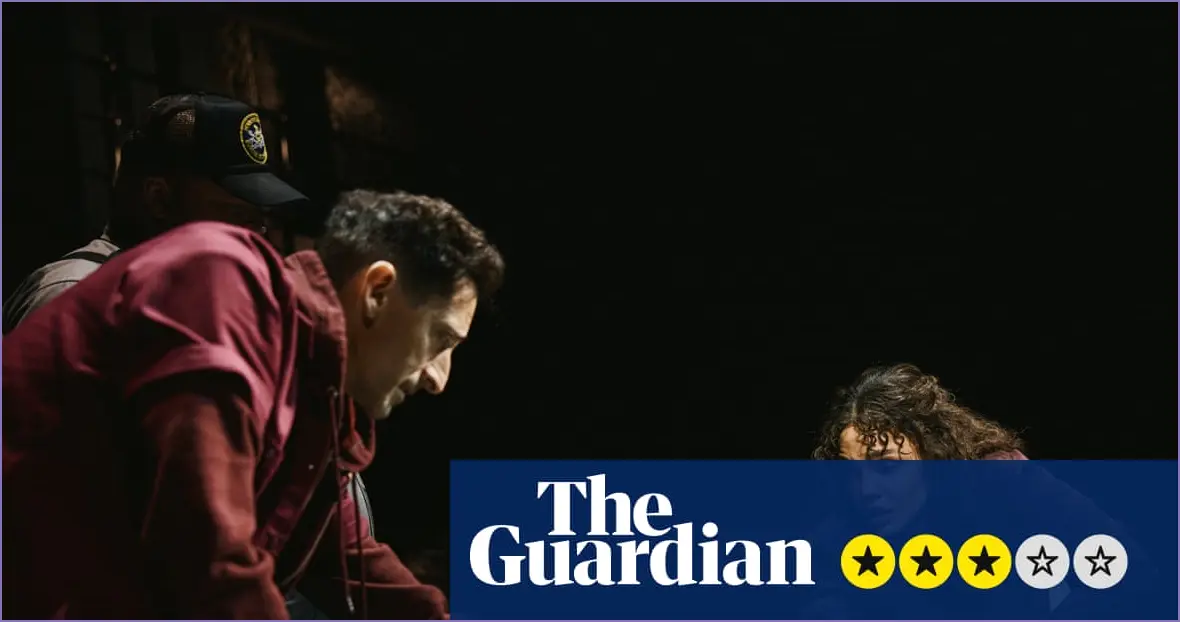
If the essence of Death of a Salesman seems too pricy, a short walk south and east reveals a more budget-friendly take on typical Broadway offerings. The Fear of 13, penned by Lindsey Ferrentino, is so genuine and straightforward that it might be mistaken for a film biopic aiming for awards contention. Similar to those films, Ferrentino’s work is solid, reliable, yet largely unremarkable.
The play centers on a notable true story highlighting wrongful imprisonment in the U.S. The Fear of 13 tells the tale of Nick Yarris, who endured a tumultuous childhood marked by drug addiction and car theft before being unjustly convicted of murder and sentenced to death. Yarris maintained his innocence throughout his 22 years on death row, seeking legal help and marrying a volunteer named Jackie Schaffer while imprisoned. Ultimately, he was exonerated through DNA evidence, transforming his ordeal into a memoir and documentary that forms the basis of the play.
Ferrentino and director David Cromer make a concerted effort to elevate this linear narrative, mostly set in the confined space of a prison, into something more theatrical. Cromer, recognized for his exceptional productions of The Adding Machine and Our Town, incorporates a midcentury modern aesthetic. Characters often exist in small pools of light, directly addressing the audience, while more dynamic scenes are organized into presentation tableaux. The play itself becomes a reflection of its own theatricality, evoking a Brechtian quality.
However, it’s disappointing that the script lacks inventiveness. It tends to follow a predictable outline of Yarris’s prison years, particularly focusing on his interactions with Schaffer, dubbed Jacki in the play. These exchanges reveal key aspects of Yarris’s history, but the storytelling often feels rushed, with limited moments of deep emotion—except for a poignant musical scene where two imprisoned lovers sing to each other. Although Ferrentino’s writing can be crisp, attempts at lyrical expressions sometimes sink into vagueness and cliché, particularly during the overstuffed final monologue.
The play also suffers from imbalanced pacing. There’s an extended setup before Yarris and Jacki’s relationship commences, which is then accelerated to meet the unbroken 110-minute runtime. While the oppressive atmosphere of Yarris’s life is palpable, the intensity of his connection with Jacki, which helped him transcend despair, is underdeveloped, making her character feel more like a narrative tool than a partner.
This underdevelopment is unfortunate, as Tessa Thompson brings a warm, understated performance to the role, complementing co-star Adrien Brody, who reprises his role after a London run. Brody leans into a hammy portrayal with an ambiguous accent—diverging from Yarris’s real Delaware roots—but the duo shares an authentic chemistry in moments of intimacy.
As the play reaches its climax, Brody embraces the melodramatic aspects of the scene. Yarris’s unique story morphs into a broader exploration of life’s often-overlooked beauty, a sentiment more compellingly depicted in works like Our Town. While one leaves The Fear of 13 feeling disturbed by the injustices Yarris faced and moved by his path to freedom, the emotional impact is fleeting. Ferrentino and Brody have not delved deeply enough to leave a lasting impression, rendering the experience more soothing than searing.
