


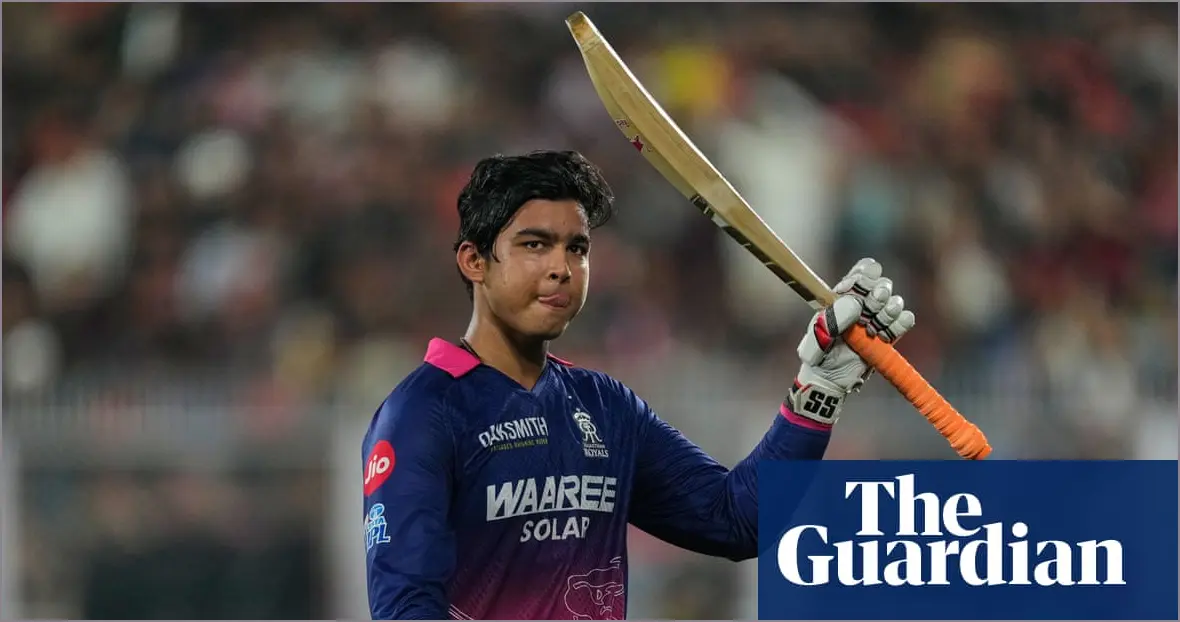
When Jasprit Bumrah took his position for the Mumbai Indians against Rajasthan Royals in this year’s Indian Premier League, he embodied the definition of a complete bowler across formats. His explosive whiplash action, reminiscent of a stick of dynamite, lets him unleash blistering yorkers and towering bouncers with ease. Just three balls later, he set the stage for a budding star.
Prior to this moment, Bumrah, who has secured five IPL titles and two World Cups, had bowled 5,445 balls in T20 matches for Mumbai and India, with only 180 of them resulting in sixes. This means he allows an average of a maximum every five overs. Since 2013, he has been a game-changer, making an impact in nearly every match. However, that didn’t seem to faze 15-year-old Vaibhav Sooryavanshi.
Sooryavanshi’s first shot off Bumrah went sailing over wide long-on, and his third was smashed over deep-backward square. In just half an over, Sooryavanshi had outperformed all global batters by nearly 1,900%. After the initial shock wore off, the question arose—were we witnessing the ascent of cricket’s next prodigy?
“The short answer is we can’t know for sure, and anyone who claims otherwise is misleading you,” explains David Court, head of player identification at the England and Wales Cricket Board. “It involves many factors and their interaction. If you’re eager for a single, definitive answer, you’re limiting your perspective.”
In essence, Court’s role revolves around this uncertainty. He leads the discovery and nurturing of England’s finest young talent, while coordinating a network of scouts on the lookout for future stars like Joe Root or Jimmy Anderson. This process is complicated, particularly as teenage brilliance often comes with challenges and misdirection.
“We monitor various aspects,” says Court. “While talent is crucial, we ultimately seek mental toughness. This concept is broad and manifests in various ways, but it essentially revolves around overcoming adversity.” A study published in Sports Medicine highlights that talent thrives on overcoming obstacles, which can be as mundane as poor form or being deciphered by opposing teams. The pivotal trait is how players respond to these challenges under pressure.
Adams, a former South African bowler, watched Sooryavanshi during the Under-19 World Cup, where the young Indian scored 439 runs, including a stunning 163 against England in the final with a strike rate of 169.49. “He’s unbelievable,” Adams remarks. His interest lies in how Sooryavanshi adapts when the inevitable tough times come. “When top bowlers start to read him, will he have strategies beyond just hitting?”
