


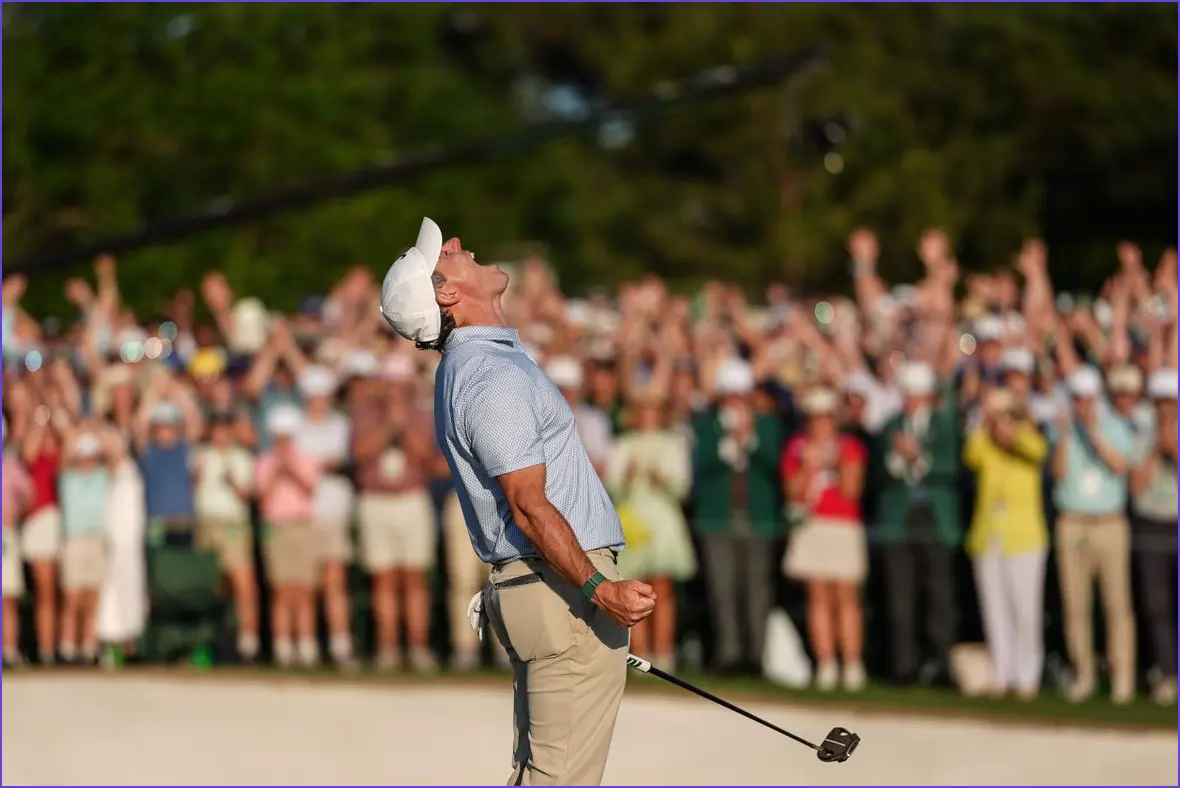
Rory McIlroy’s Masters Triumph
With his parents, Rosie and Gerry, looking on from behind the 18th green, Rory McIlroy marked his place in history by becoming the fourth golfer to reclaim the Masters title. Last Sunday, the Grand Slam champion joined elite company with Jack Nicklaus, Nick Faldo, and Tiger Woods as he achieved back-to-back victories at Augusta.
Leading by a remarkable six shots after two rounds, McIlroy chose to navigate the challenges in his typical fashion, determined to face the pressure head-on. Although the weekend brought some challenges, fewer than in 2025, he maintained his composure to finish at 12 under par, edging out two-time champion Scottie Scheffler by a single stroke.
On the final hole, McIlroy, whose driving accuracy had faltered during the tournament, encountered trouble, finding the trees. His heart rate reflected the mounting pressure, spiking to 135 beats per minute (BPM) as reported by Whoop, the wearable tech company that McIlroy supports and which monitored his heart rate throughout the competition.
As he approached his second shot, McIlroy managed to lower his heart rate to 121 BPM. However, after hitting his ball from near the 10th fairway into a bunker, his heart rate surged again to 136 BPM while chipping out onto the green. To reclaim his Green Jacket, McIlroy only needed two putts to avoid a playoff with Scheffler.
This cushion allowed him to relax, lowering his heart rate to 117 BPM for the first putt and further to 105 BPM as he made the final tap-in to secure his victory. As he celebrated becoming a six-time major winner, his heart rate spiked to 150 BPM, accompanied by an exuberant roar.
Learning to manage and lower one’s heart rate in high-pressure situations is crucial for athletes. McIlroy relies on controlled breathing, often reminding himself to take calm, nasal breaths to regulate his nervous system, as explained by David Jackson, a breath work expert. He emphasizes the importance of breathing through the nose over the mouth to convey signals of safety to the brain.
Jackson notes that optimal breathing involves controlling respiratory rates and aligning the rib cage and diaphragm correctly. He suggests that athletes often err by breathing too forcefully rather than focusing on calm, measured breaths. Additionally, McIlroy excelled in sleep quality during the Masters, averaging eight-and-a-half hours per night, aligning with recommendations from sleep specialist Cheri D. Mah.
