


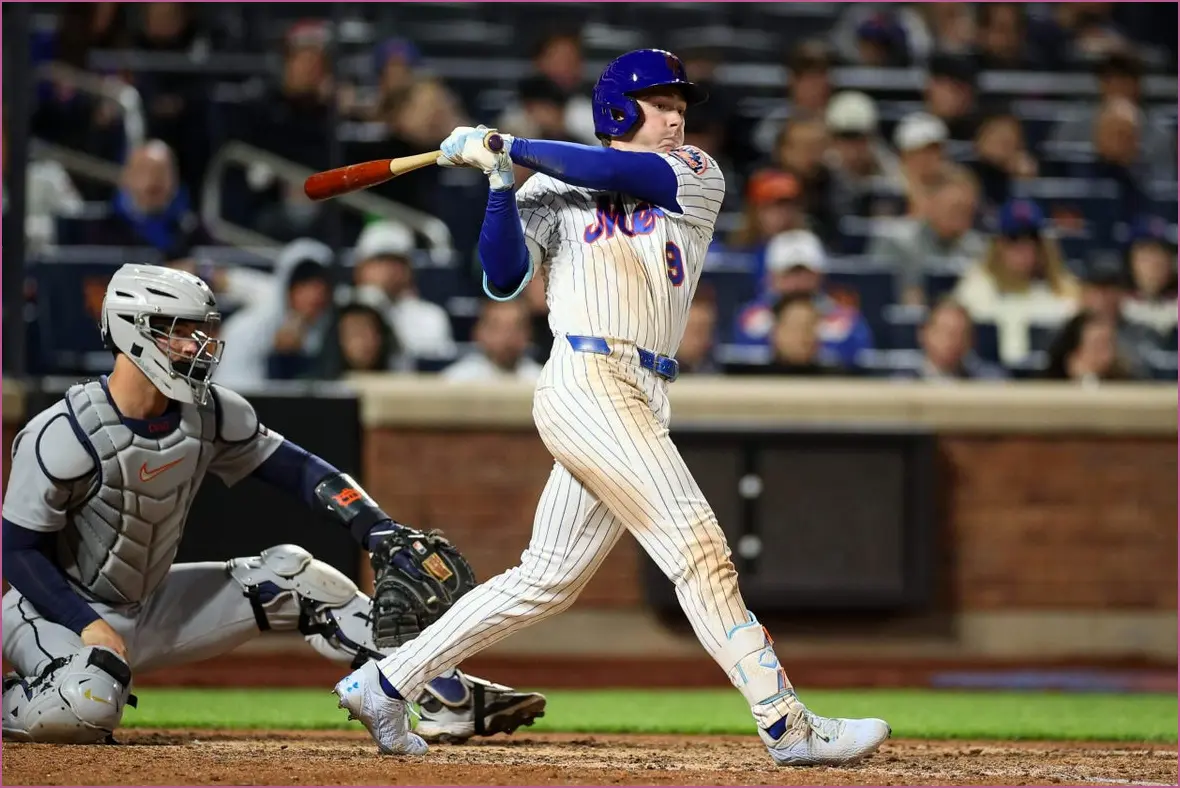
As the season progresses, emerging players are receiving call-ups, particularly when veteran players face difficulties or injuries. This scouting column highlights hitters and pitchers whose approaches or strategies have notably changed. These trends may clarify the early-season performances of these players, whether they point to a breakout or reveal weaknesses.
CF A.J. Ewing, NYM
Just over a year ago, Ewing was a relatively unknown Single-A prospect without exceptional skills. Now, at 21, he’s secured a spot in the starting lineup for the New York Mets.
Andrea Analyzes Ewing’s Skills
Minor League Performance
Drafted in 2023 from high school, Ewing played in Rookie Ball and Low A during the 2023-24 seasons. Though he exhibited athleticism and good speed, he struggled with hitting and power, finishing the 2024 season with a 29% strikeout rate. However, in the 2025 season, he demonstrated considerable improvement, with a strikeout rate of just 12% in Low A and a batting average of .400. His increased contact ability allowed him to capitalize on his speed, resulting in a notable 19% walk rate, which was more than his strikeouts.
Continuing his momentum at the start of the current season, Ewing was promoted from Double A to Triple A just weeks in. With 132 plate appearances across both levels, he boasted a remarkable slash line of .339/.447/.514, with a 19% walk rate and a 16% strikeout rate. This strong performance, combined with injuries to major-league players, led the Mets to include him on their 40-man roster.
Major League Impact
In his early major league appearances, Ewing has exhibited plate discipline typical of seasoned veterans. Out of the 90 pitches he faced before Monday, he swung at only seven. His ability to extend at-bats and draw walks was highlighted when he walked three times in his debut game.
Quality contact has been another highlight, with Ewing recording hits characterized by high exit velocities and line-drive angles. His performance indicates he is not merely a slap hitter but rather a line-drive hitter who emphasizes the quality of his contact. One area of improvement for Ewing is to balance his patient approach with assertiveness; following his first game, pitchers began attacking the strike zone more, leading to some uncharacteristic strikeouts. Maintaining his ability to control at-bats will be crucial as he adapts to major league pitching.
RHP Zack Littell, WSH
This season, Zack Littell’s performance has severely declined, currently holding a 6.94 ERA over 36.1 innings pitched. Although his numbers are concerning against both right and left-handed hitters, his struggles against righties are especially alarming, given he enjoys a platoon advantage.
Background
In his successful seasons as a starter (2024-2025), Littell showcased several key strengths: getting ahead in counts, limiting walks, generating chases, and managing damage despite allowing contact. He typically utilized a five-pitch mix, with his slider serving as the most effective weapon. Early in counts, he leaned on his slider and sinker, while in two-strike situations, he would rely on the splitter and four-seamer.
2026 Challenges
This season, Littell still manages to get ahead in counts but struggles to generate chases, leading to more hard contact against him. While he used to heavily rely on the splitter in critical situations, its usage in early counts has decreased, diminishing its impact. His increased reliance on the sweeper has made at-bats more predictable for hitters, who are no longer swinging at his slider, resulting in a chase rate drop from 32% to 14%. This change has weakened Littell’s effectiveness, as his success has historically depended on inducing swings outside the zone through strategic pitch sequencing.
3B Alec Bohm, PHI
Alec Bohm is having a disappointing start to the 2026 season, hovering around .200—far below his career .275 average. His struggles are particularly evident against fastballs, which he sees 61% of the time but is currently mishitting.
Bohm’s patterns reveal that he’s failing to drive outer-half fastballs and is frequently jammed on inner-half pitches, resulting in ground balls and popups—a career-high popup rate of 8%. Despite maintaining similar swing mechanics to previous seasons, he is not making solid contact. Pitchers seem to be exploiting these weaknesses by attacking him effectively, while his .230 BABIP suggests he has faced a mix of bad luck and inconsistency in contact quality.
Additional Notes
- Daniel Schneemann of the Guardians possesses a .754 OPS but has a concerning 30% strikeout rate. Despite this, he has improved his batted-ball profile by hitting more line drives.
- Spencer Jones, Yankees’ top prospect, has reached the majors but struggles with contact, shown by nine strikeouts in 21 plate appearances.
- Tyler Soderstrom of the Athletics has a low .650 OPS but is making underlying improvements, including reducing his ground-ball rate and pulling the ball in the air more consistently.
