


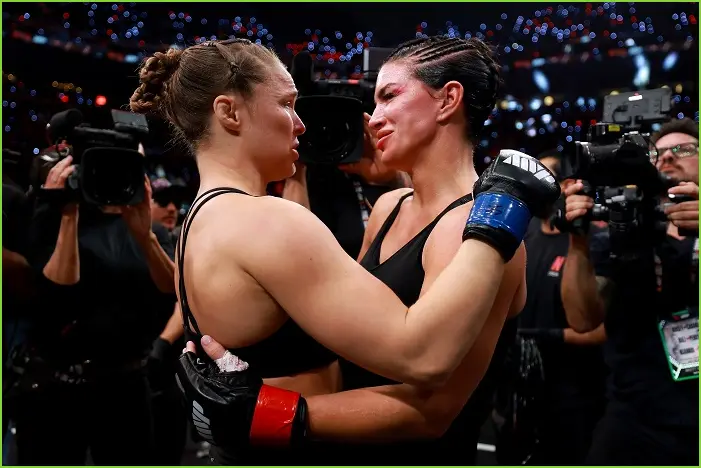
MVP made its debut in mixed martial arts on Netflix this past Saturday, drawing significant attention to the platform.
The event featuring Rousey and Carano was a hot topic, creating a buzz on social media and increasing traffic across various platforms. It was a successful day for MMA, at least in terms of engagement.
However, the event was not without criticism. MVP MMA’s card was imperfect and faced scrutiny. Still, one critical takeaway is that competition benefits the sport. Unlike team sports, MMA is more aligned with boxing or professional wrestling. Fans of 90s wrestling would agree that the “Monday Night Wars” between WWE and WCW spurred innovation in both companies.
Could MVP MMA reinvigorate the UFC, which appears stagnant in 2026? Only time will tell, but Rousey vs. Carano hinted that change is feasible.
Debunking the Claims of a Rigged Fight
One of the most absurd discussions following the Rousey vs. Carano bout was the accusation of a rigged fight. Critics on social media claimed “fix!” as if rigging an expected outcome would make any logical sense.
Carano was a considerable underdog, returning after a 17-year hiatus and losing 100 pounds for the fight. Rousey proposed the matchup partly to motivate Carano, indicating their friendship wouldn’t negate their competitive spirit. Accusations of foul play reflected more on the critics’ desperation for drama than any reality.
Actual fight fixing in MMA is exceedingly rare. Historical examples, like Tae Hyun Bang’s fight in 2015, underscore this rarity. Although Bang was found guilty of attempting to fix his fight, he ultimately didn’t go through with it due to unexpected circumstances.
Reflecting on Rousey’s career, her dominance was established through quick finishes in title defenses. Those dismissing her victory should consider the clear expectations set before fight night.
MVP MMA’s Status as a Promotion
Another misguided opinion is that MVP MMA’s significance diminishes because it doesn’t operate like traditional promotions. The reality is that this distinction may not matter as much as some think.
MVP operated on a budget provided by Netflix, showcasing its potential through high-profile matchups. This model diverges from the typical promotion approach that often ties fighters into exclusive contracts, limiting their earning opportunities.
Netflix engaged in negotiations with the UFC, aiming to secure a competitive edge, but ultimately opted for a different route, allowing for flexibility with events and contracts. If MVP continues on its current path, it might offer more favorable conditions, particularly avoiding restrictive exclusive agreements.
For instance, Rousey earned a reported $2.2 million for her fight, while Carano took home over $1 million. Comparatively, these earnings far exceed entry-level payouts seen in the UFC, showcasing an appealing alternative for fighters.
In conclusion, the emergence of a financially rewarding organization for fighters, even in limited scenarios, can only benefit MMA as a whole.
